
UGC creator taxes: 1099s, quarterly payments & write-offs
Everything UGC creators need to know about 1099-NEC vs 1099-K thresholds, quarterly estimated taxes, and which business expenses are deductible.

I got hit with a $3,200 tax bill I wasn't expecting in my first year doing UGC full-time. Not because I made a lot of money — I did fine — but because nobody told me the rules had changed the moment I stopped being an employee. No withholding. No employer picking up half my Social Security. Just a lump sum I owed the IRS in April that I absolutely did not have sitting around.
That's the thing about UGC creator taxes and the 1099 system nobody warns you about when you're hyped about landing your first brand deal.
So let me give you the actual breakdown — the forms, the deadlines, the deductions. Not the watered-down version.
What a 1099 means for UGC creators (and which form you'll actually get)
Once you earn money as an independent contractor, you're in 1099 territory. There are two forms that matter for UGC work specifically.
The 1099-NEC is what most brands and platforms send when they pay you directly for content creation services. NEC stands for "Nonemployee Compensation." If a brand paid you $600 or more in a calendar year, they're required by the IRS to send you a 1099-NEC by January 31st. Under $600 from a single brand? They don't have to send one — but you still owe tax on that income. That's a trap a lot of new creators fall into.
The 1099-K comes from payment processors — think PayPal, Venmo Business, Stripe, or any platform that processes credit card payments. The threshold here has been messy. For 2024, the IRS set the threshold at $5,000 (down from the old $20,000 cliff), and they're phasing it down to $600 over the next couple years. If you're invoicing brands through Stripe or a similar processor, you'll likely see 1099-Ks showing up even for modest income.
The critical thing to understand: these two forms can overlap. A brand might pay you $2,000 through PayPal. You could get both a 1099-NEC from the brand and a 1099-K from PayPal for the same payment. Don't double-count it as income. Report what you actually earned, not the sum of both forms.
IRS heads-up: Even if no brand sends you a 1099, you're legally required to report all income over $400 from self-employment. The IRS doesn't need the form to find the income — brands deduct their payments as business expenses, which creates a paper trail.
The self-employment tax problem nobody mentions at the start
Here's what caught me off guard. As an employee, your employer pays half your Social Security and Medicare taxes (7.65%). As a self-employed UGC creator, you pay both halves — the full 15.3% — on top of your regular income tax.
So if you're in the 22% federal income tax bracket and you earn $50,000 from UGC work, your effective tax rate on that income is closer to 37%. That number hits different when you're used to seeing a paycheck with taxes already pulled out.
The IRS lets you deduct half of your self-employment tax on your Schedule SE, which softens it a bit. But the core point stands: set aside more than you think you need.
A rough rule I give creators starting out: set aside 25–30% of every payment the moment it hits your account. If you're earning $5,000/month from brand deals, that's $1,250–$1,500 going straight into a separate savings account before you touch anything else. Open a dedicated "tax" account and treat it like the money doesn't exist.
Quarterly estimated tax payments: the four dates you can't miss
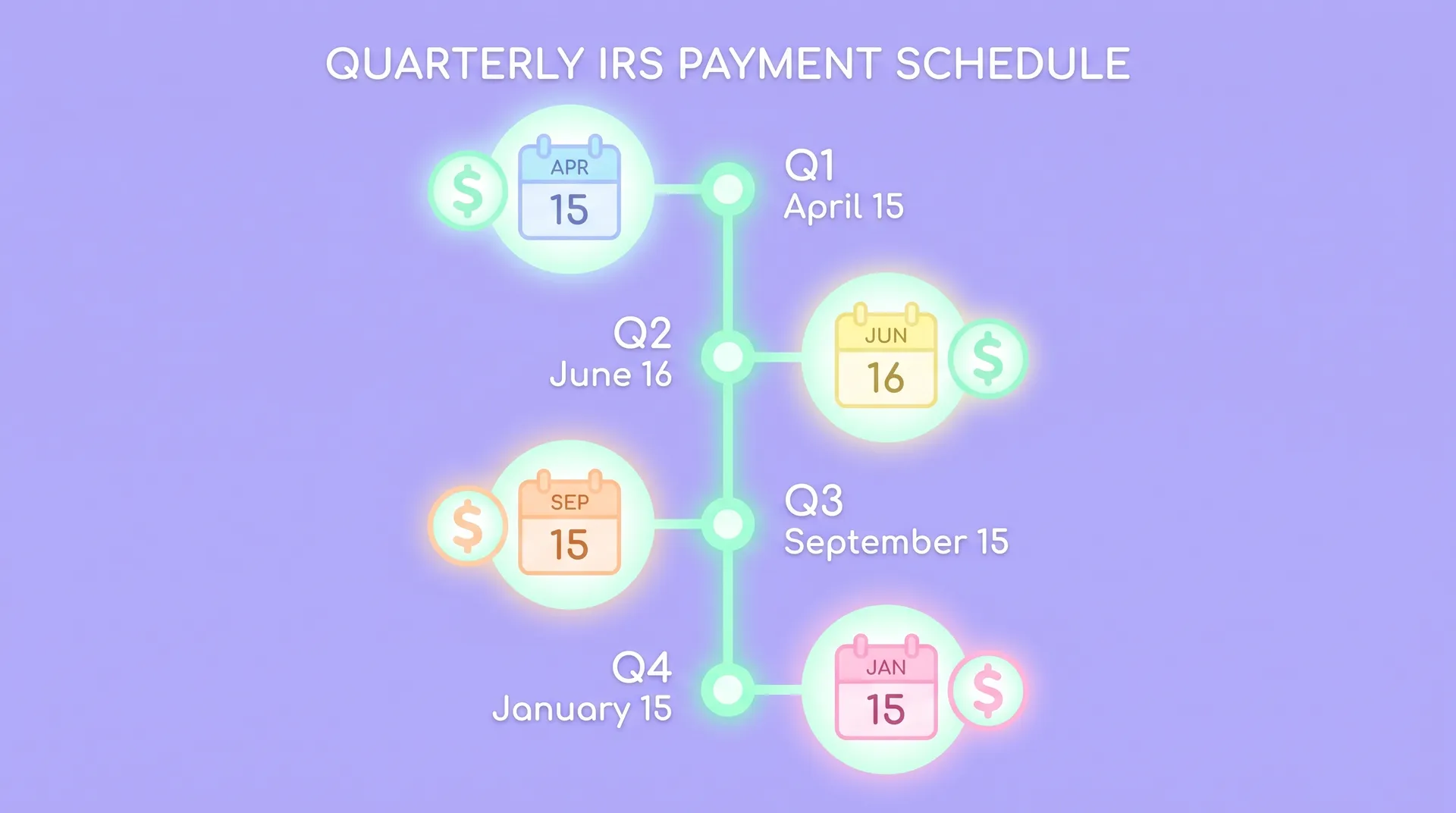
The IRS wants their money four times a year, not once in April. If you expect to owe $1,000 or more in federal taxes for the year, you're required to make estimated quarterly payments. Miss them, and you get hit with an underpayment penalty — currently around 8% annualized, which is basically the IRS charging you interest on money you should have sent earlier.
The 2025 quarterly estimated tax deadlines:
| Quarter | Income covers | Due date |
|---|---|---|
| Q1 | Jan 1 – Mar 31 | April 15, 2025 |
| Q2 | Apr 1 – May 31 | June 16, 2025 |
| Q3 | Jun 1 – Aug 31 | September 15, 2025 |
| Q4 | Sep 1 – Dec 31 | January 15, 2026 |
Notice Q2 is only two months. That one trips people up constantly.
You can pay directly at IRS Direct Pay — free, no account needed. Set a recurring calendar reminder the week before each due date. Seriously, put it in your phone right now.
How much do you actually send each quarter? Two solid approaches:
- Safe harbor method: Pay 100% of last year's tax liability in four equal installments (110% if you earned over $150,000 last year). Do this and the IRS won't penalize you even if you underpay, regardless of what you earn this year.
- Actual income method: Estimate your current-year income and tax owed, then divide by four. More accurate, but requires tracking your income monthly.
For most UGC creators with inconsistent income, I lean toward the safe harbor method in year one. It removes the guesswork when your deal flow is still unpredictable. In year two, once you have a full year of income data, you can get more precise.
State taxes too: Most states with income taxes have their own quarterly estimated payment requirements. Check your state's revenue department — due dates and thresholds vary. California, for instance, has a weird Q1/Q2 combined payment schedule.
UGC business expenses you can actually deduct
This is where you get some money back. The IRS lets you deduct "ordinary and necessary" business expenses against your self-employment income, which reduces both your income tax and your self-employment tax. Every legitimate dollar you write off is saving you roughly $0.37–$0.40 depending on your bracket.
Here are the deductions that are genuinely defensible for UGC creators:
Equipment and gear Your phone (the percentage used for work), a gimbal, ring light, LED panels, a microphone, a tripod. If you bought it primarily for content creation, it's deductible. If you use your phone 70% for work, deduct 70% of it. Keep your receipts and document the business purpose.
Software and subscriptions Editing apps like CapCut Pro or Adobe Premiere, Canva, your portfolio hosting, any project management tools, music licensing subscriptions. If it's used for your UGC business, write it off.
Home office deduction If you have a dedicated space — even a corner of a room — used regularly and exclusively for your UGC work, you can deduct it. The simplified IRS method gives you $5 per square foot, up to 300 sq ft, no receipts required. The regular method lets you deduct a proportional share of rent, utilities, and internet based on the square footage of your workspace.
Internet and phone bills Deduct the business-use percentage. Most creators can justify 50–80% without issue if content creation is their primary work.
Props, products, and staging The skincare products you bought to film a demo, the kitchen items you staged for a cooking brand deal, the gym clothes you wore on camera. If they were purchased specifically to fulfill a brand deal and you can document that — deductible.
Education and professional development Courses, books, industry memberships, paid newsletters about the creator economy. Anything you spend on learning that directly relates to your UGC business.
Professional services This one's big and often missed: the accountant or CPA you hire to file your taxes? Deductible. The attorney who reviewed your UGC contract for red flags or checked your usage rights agreements? Deductible. Any professional you pay to protect or manage your business.
Travel and on-location shoots If a brand flew you to a location or you drove to a shoot, those costs are deductible. Mileage for business driving is deductible at the IRS standard mileage rate (67 cents per mile for 2024). Keep a log — the IRS loves documentation.
What you can't deduct: Your regular personal clothing (even if you wear it on camera), restaurant meals where you're eating alone and calling it "content research," personal vacations with a one-hour content shoot tacked on, or any expense that's primarily personal. The IRS looks for patterns, and pushing lifestyle expenses through your business is the kind of thing that triggers an audit.
Track everything in real time. Don't try to reconstruct expenses from memory in March. I use a simple spreadsheet with date, amount, vendor, and business purpose. Takes two minutes per transaction and saves hours at tax time. Apps like QuickBooks Self-Employed or Wave automate most of this.
Should you set up an LLC or S-Corp?
Short answer: an LLC is worth the protection even in year one. An S-Corp election starts making financial sense once you're clearing around $50,000–$60,000 in net profit annually — at that point, the self-employment tax savings from paying yourself a reasonable salary and taking the rest as distributions can meaningfully exceed the cost of a payroll service.
This is genuinely a "talk to a CPA" decision. The math is specific to your income level, your state, and how much you're earning from UGC vs. other sources. What I'll say is: don't let the business structure question paralyze you. File as a sole proprietor, get your finances organized, then revisit the structure question when the numbers make it worth the administrative overhead.
The same way you protect your income by putting clear terms around licensing fees and kill fees in contracts, you protect it on the tax side by keeping organized books from day one.
The $400 threshold and why it matters
Net self-employment income over $400 in a year? You must file a tax return and pay self-employment tax, even if your total income is below the standard filing threshold. This catches a lot of creators who did a couple of small brand deals while still at a day job and figured the amounts were too small to matter. They're not.
File anyway. The penalties for non-filing compound over time, and the IRS finds things eventually because of the trail brands leave when they deduct their content spending as a business expense. You're always better off being proactive.
Also worth knowing: the IRS Free File program is available to taxpayers earning under $79,000 adjusted gross income. And SCORE offers free mentorship from retired business professionals, including people who can walk you through self-employment finances when you're just starting out.