UGC licensing fee: how to calculate what to charge
Learn how to calculate a UGC licensing fee using platform, duration, and exclusivity as pricing levers. Real numbers, real formulas.

A brand offered me $300 for a UGC video last year. The brief said "one video, 30-day usage." I quoted $300. They came back and asked if that included "paid media rights across all platforms for 12 months." I said no. They pushed back like I was being difficult.
I wasn't being difficult. I just hadn't built my UGC licensing fee into the quote — and that gap almost cost me real money.
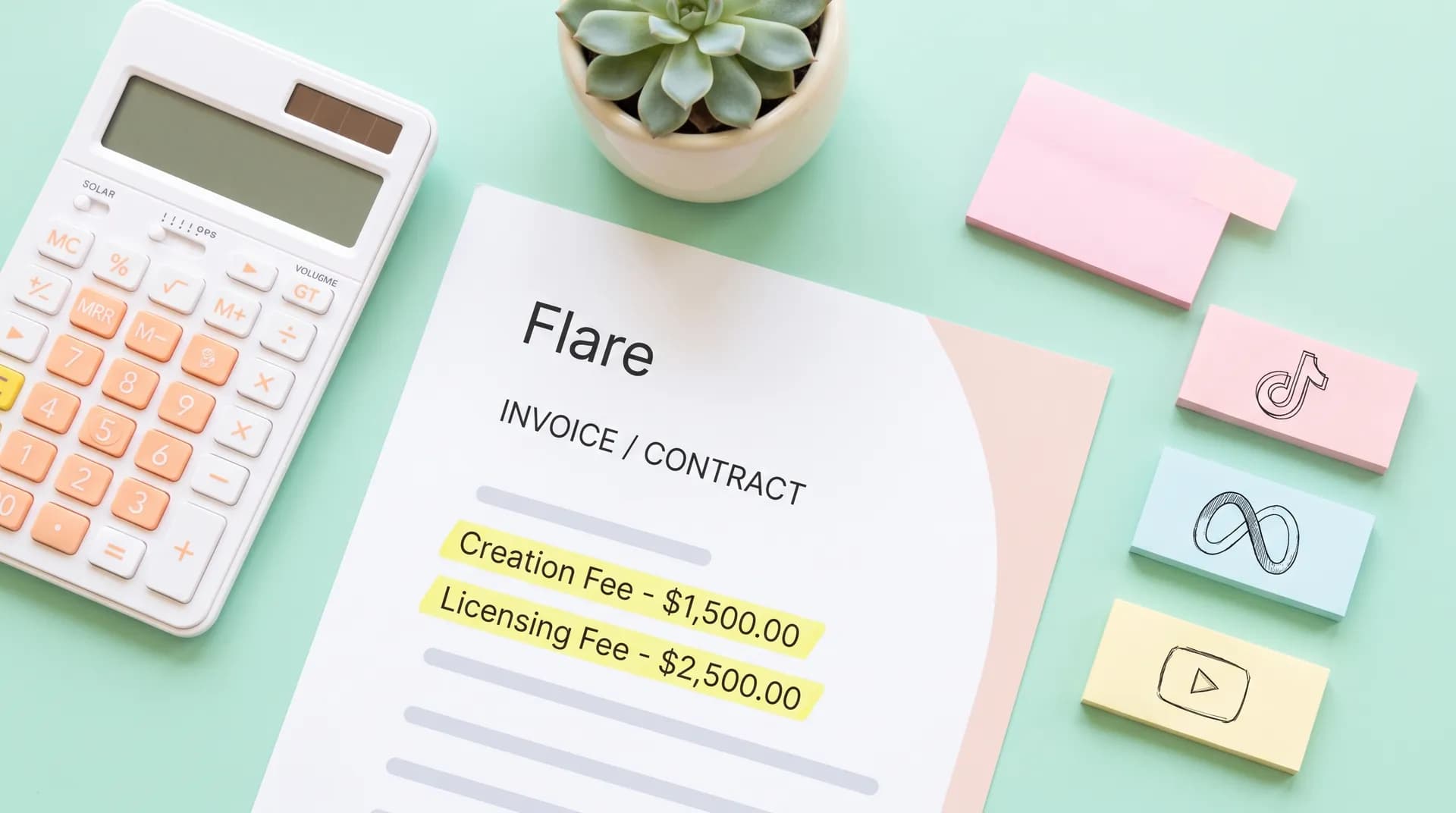
If you've ever sent a rate and then watched the brand quietly repost your content in Meta ads for six months without paying a cent more, you already know the problem. The creation fee and the licensing fee are two separate things. Most new creators don't charge for the second one at all. This post is specifically about how to calculate that licensing fee — the usage-rights add-on that sits on top of your base creation rate.
What a UGC licensing fee actually is
Your creation fee covers your time. Scripting, filming, editing, delivering. That's the labor.
The licensing fee covers what the brand does with the asset after delivery. It's compensation for the commercial value they extract from your content — running it in paid ads, publishing it on their website, whitelisting it through their ad account, repurposing it across channels.
Think of it like a photographer selling a photo. You pay the photographer to take the shot. You pay again — separately — for the right to print it on 10,000 billboards. UGC works exactly the same way.
The problem is that most brand contracts don't frame it this way. They bury usage rights in a clause that says something like "perpetual, worldwide, royalty-free license across all media." If you sign that without adjusting your rate, you've just given away your licensing rights for free. I break down how to spot that kind of language in the guide to UGC usage rights: the complete creator guide — worth reading alongside this one.
Your licensing fee is the dollar amount you charge to grant those rights. It's calculated separately from creation and added as a line item on your invoice.
The three levers that set your licensing fee
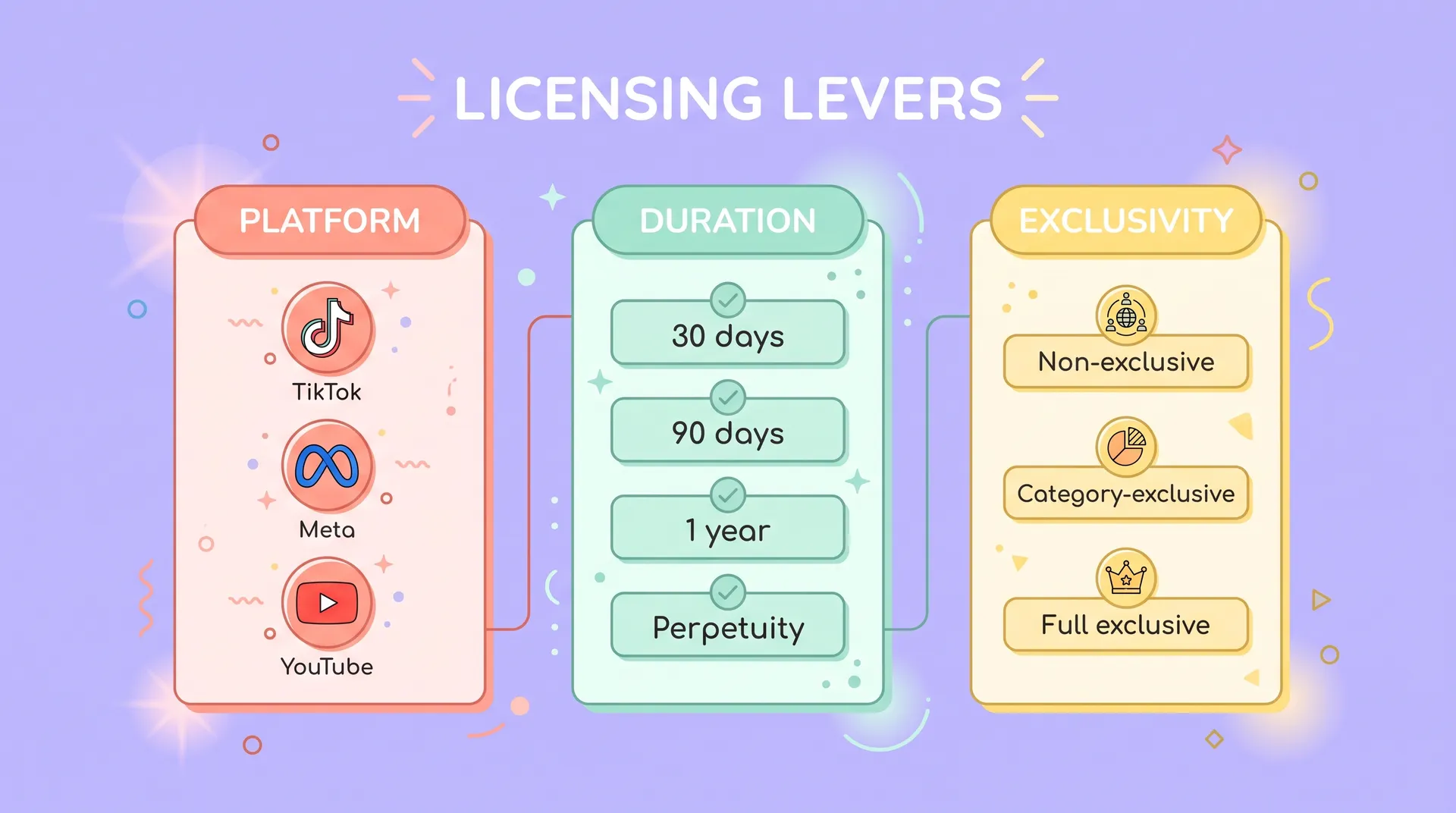
Every UGC licensing fee is built from three variables. Get these right and you can quote confidently every time.
Lever 1: Platform
Where the brand runs your content matters enormously. Organic social posts have limited reach. Paid Meta ads can be shown to millions of people, scaled with budget, and retargeted indefinitely. The more commercial the placement, the higher the fee.
Here's how I roughly tier platforms:
- Organic social only (brand's own Instagram/TikTok feed, no paid): lowest multiplier, sometimes even included in creation fee for short-term organic deals
- Paid social (Meta, TikTok Ads): significant jump — this is where your content becomes a revenue-generating asset
- Whitelisting / allowlisting (running ads from your handle): add a premium on top of paid social — I cover exact numbers in the UGC whitelisting rights: what they are & what to charge post
- Streaming / OTT / connected TV: niche but increasingly common for D2C brands — commands the highest rates
A practical starting point: set your base creation fee for organic rights, then add 30–50% on top for paid social on one platform. Each additional platform stacks.
Lever 2: Duration
How long the brand can run the ad is the single biggest driver of licensing value. A 30-day paid campaign is very different from a 12-month evergreen ad.
Standard tiers I use:
- 30 days: 20–25% of creation fee
- 90 days: 35–50% of creation fee
- 6 months: 60–75% of creation fee
- 12 months: 100% of creation fee (i.e., double your base rate)
- Perpetuity / lifetime: 150–200% of creation fee, minimum
That last one is important. Perpetuity isn't just "a long time." It's forever. Brands love to slip perpetuity clauses into contracts because they sound routine — they're not. If you need more context on how to push back, the perpetuity clause UGC guide covers it in full.
Lever 3: Exclusivity
Exclusivity is the most underpriced lever in UGC deals. When a brand asks for exclusivity, they're asking you to turn down every competitor in that category for a set period. That's real opportunity cost.
Three levels to price differently:
- Non-exclusive: no premium — you can still work with competitors
- Category exclusivity: you can't work with competing brands in their vertical (e.g., no other skincare brands for 60 days). Add 25–40% to your licensing fee
- Full exclusivity (can't post competing content anywhere, including your own channels): add 50–75%. This should also come with a shorter time window — anything over 90 days at full exclusivity is worth negotiating hard on
For a deep read on how long exclusivity windows should actually run, see exclusivity clauses in UGC deals: how long is too long?
Putting the formula together
Here's the simple math I actually use when building quotes.
Total project fee = Creation fee + Licensing fee
And the licensing fee:
Licensing fee = (Creation fee × Duration multiplier) × Platform multiplier × Exclusivity multiplier
Let's walk through a real example.
Say your base creation fee for one UGC video is $400.
The brand wants:
- Paid Meta ads (one platform)
- 90-day usage
- Category exclusivity in fitness
Step by step:
- Start with $400 (creation)
- 90-day licensing: $400 × 0.40 = $160
- Paid Meta multiplier: $160 × 1.35 = $216
- Category exclusivity: $216 × 1.30 = $281
Round it. Your licensing fee is approximately $280.
Total invoice: $400 + $280 = $680.
Without that licensing line item, you would've invoiced $400 and the brand would've run paid ads with your face on them for three months.
You don't need to show the brand your math. Just present a clean invoice with two line items: "Video creation — $400" and "Usage rights (paid Meta, 90 days, fitness exclusivity) — $280." Most brands expect this. The ones who push back hard are usually trying to get rights for free — which is a red flag worth noting.
A note on revision and the "all platforms" trap
Watch out for briefs that say "usage across all platforms and channels." That phrase is doing a lot of work. It means TikTok Ads, Meta Ads, YouTube pre-roll, their website, email campaigns, out-of-home digital — everything. Forever, if they also add perpetuity.
Price it that way. If a brand wants truly unlimited, all-platform rights, your licensing fee should be at least equal to — and often larger than — your creation fee.
I've seen creators quote $250 for a video and then sign a contract granting unlimited rights across all channels in perpetuity. That's not a UGC deal. That's a buyout at a fraction of the value.
The UGC contract red flags post lists the exact language to watch for before you sign anything.
When to negotiate vs. when to hold firm
Brands will sometimes say "we don't pay separately for usage rights — it's included." That's a negotiating position, not a fact. Everything is negotiable.
Where I hold firm:
- Paid ads of any duration. Non-negotiable separate line item.
- Whitelisting. Always an add-on.
- Perpetuity. If they won't move off perpetuity, the fee goes up significantly.
Where I have flexibility:
- Short organic deals (under 30 days, no paid). Sometimes I include this in the creation fee for new brand relationships.
- Repeat clients with retainer agreements. I build usage into the monthly retainer rate rather than itemizing every video — covered more in the UGC creator retainer packages post.
The goal isn't to nickel-and-dime every brand. It's to make sure you're compensated fairly when your content is generating real commercial value for them. That's not difficult. That's just business.
FAQ
Frequently Asked Questions
What is a UGC licensing fee?
How much should I charge for UGC usage rights?
Do brands always pay a separate licensing fee?
What's the difference between a creation fee and a licensing fee?
Can I charge more for exclusivity in UGC deals?
What happens if a brand uses my UGC without paying for rights?
Related reading
- UGC usage rights: the complete creator guide
- UGC license types: what every creator must know
- UGC whitelisting rights: what they are & what to charge
- Perpetuity clause UGC: what it means & how to fight it
- Exclusivity clauses in UGC deals: how long is too long?
- UGC contract red flags: 9 clauses to reject or edit
- How to read a UGC contract before you sign