UGC marketing budget: how much brands should spend
Per-video costs, platform fees, usage rights add-ons — here's how to build a monthly UGC marketing budget that maps to your media spend without overpaying.

A brand I spoke to last year was paying $2,000 per video to a boutique creative agency. The videos looked polished. They also tanked — 0.4% CTR on Meta, burned through $30K in ad spend before anyone pulled the plug. Six months later they switched to UGC, bought 12 videos for $1,800 total, and one of them became their top performer for the next quarter.
That's the UGC marketing budget conversation nobody's having clearly enough. Not "should we do UGC?" — that debate is mostly settled. The real question is: how much should you actually be spending, and on what?
I've worked with enough DTC brands, SaaS companies, and performance marketers through Flare to have opinions on this. Strong ones. Here's what I'd tell you if you were across the table from me.
What a UGC marketing budget actually needs to cover
Most brands think about UGC spend as just "paying creators." That's one piece, but it's not the whole picture. A real budget has four distinct cost lines:
1. Creator fees (per video) This is the most variable number, and it's also the one brands most often get wrong — in both directions. You'll find UGC creators charging anywhere from $75 to $600 per deliverable. The actual market rate for a competent creator doing a 30-60 second talking-head or demo video is $150–$350 per video when you're sourcing directly or through a marketplace.
Below $100? You're rolling the dice. You'll get some gems, but the revision rate and drop-off rate are brutal. Above $400 for a single non-whitelisted video with no usage rights add-on? You're probably overpaying unless the creator has a very specific audience or established track record with your category.
2. Platform or marketplace fees If you're sourcing through a UGC platform (which I'd recommend when you're just starting), budget for a markup on top of creator fees. Most platforms add 20–40% above the creator's base rate, or charge a monthly SaaS subscription — typically $300–$1,500/month depending on volume and features. See UGC creator platforms: best marketplaces for brands for a current comparison of what's out there.
3. Usage rights and whitelisting add-ons This is where brands get blindsided. A creator might quote $200 per video, but that base rate typically covers organic or owned-channel use only. Want to run it as a paid ad on Meta or TikTok? Add a usage rights fee — usually 25–50% on top of the base rate, depending on duration and channel. Whitelisting (running ads from the creator's account directly) can add another $50–$200 per video per month on top of that.
Don't skip this conversation upfront. Brands that source content without clarifying usage rights end up renegotiating every time they want to scale spend — or worse, running content they don't technically have permission to run as paid.
4. Brief and testing overhead Not a direct payment, but a real cost. Someone on your team (or your agency) needs to write briefs, review content, request revisions, and set up creative testing. For a lean DTC team buying 10–20 UGC videos per month, that's easily 5–10 hours of time. If you haven't built a strong UGC campaign brief process, you'll spend twice as long on revisions and get half the output quality.
How to size your UGC budget by stage
Here's how I'd think about the numbers depending on where your brand is:
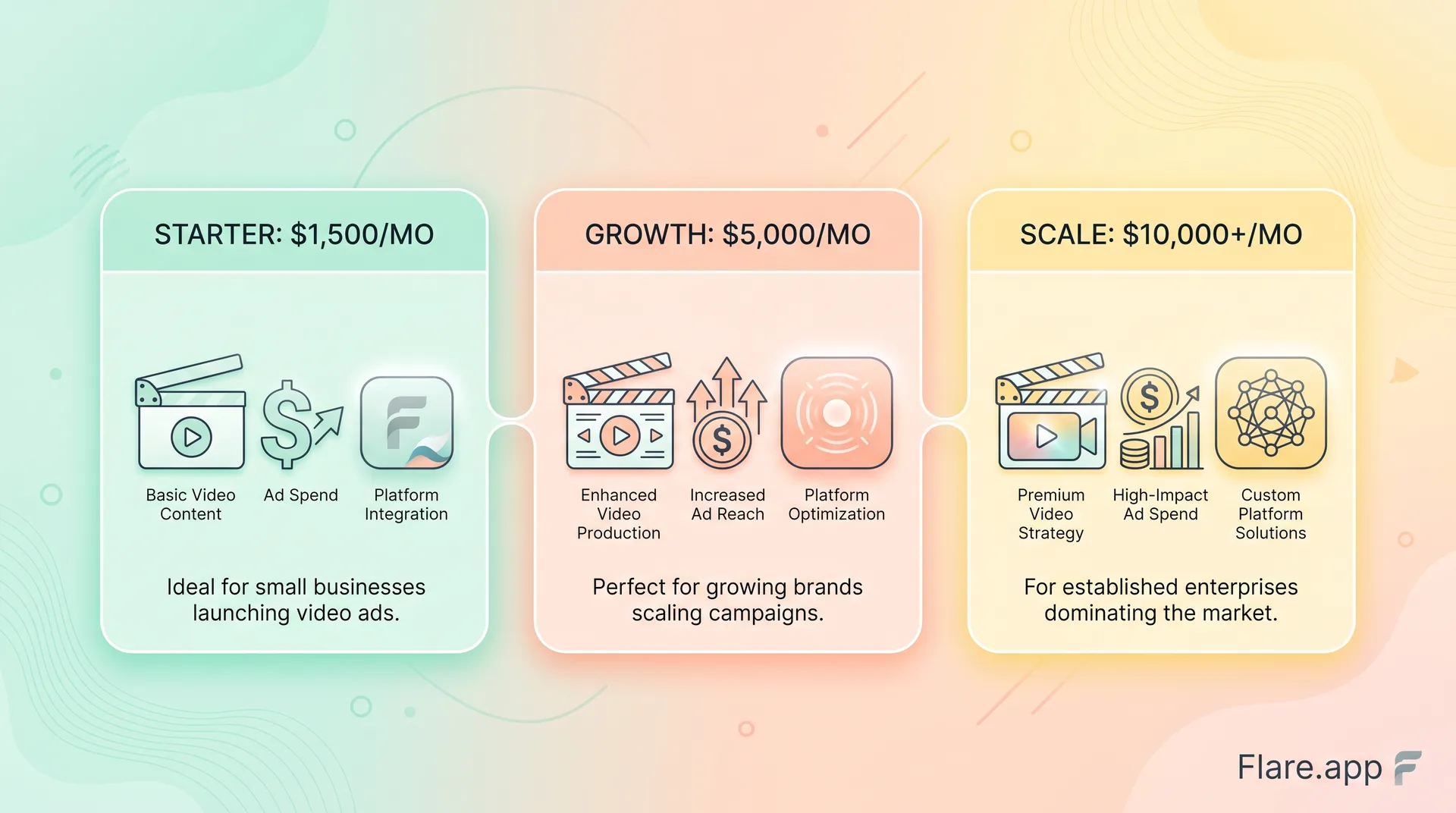
Starter: $1,500–$3,000/month
You're testing UGC as a channel. You need enough volume to run a real creative test — not just one or two videos. That means a minimum of 8–12 videos per month.
At $150–$250 per video with basic usage rights included, you're looking at $1,200–$3,000 in creator fees. Add platform access if you're using a marketplace, and you're sitting in that $1,500–$3,000 range comfortably.
At this stage, don't overcomplicate the brief. Pick one product, one audience segment, and test 2–3 different hook angles. The UGC ad creative testing framework I'd recommend doesn't require massive volume — it just requires intentional structure.
Growth: $4,000–$8,000/month
You've found 2–3 UGC formats that convert. Now you need more creative to feed your paid media machine before fatigue kills your winners. This is where most brands are when they come to me — they've proven the channel but haven't built the repeatable supply chain yet.
At this stage you should be buying 20–35 videos per month across multiple hooks, multiple formats (talking head, unboxing, demo, testimonial), and potentially multiple creators. Budget roughly $150–$250 per video in creator fees, plus $300–$800 in platform fees, plus usage rights for the top performers you scale.
One thing I see brands get wrong here: they treat every video like it needs full paid whitelisting rights from day one. It doesn't. Start with owned-channel rights, run the content organically first, identify your winners, then pay for extended paid usage on the 20–30% that actually perform.
Scale: $10,000–$25,000+/month
You're running UGC as a primary performance creative channel. You're testing 50+ creatives per month, burning through winners faster than you can replace them, and probably running both Meta and TikTok simultaneously.
At this level, you're typically splitting budget between direct creator relationships (better quality, slower pipeline) and marketplace volume (faster turnaround, more variance). Some brands at this stage bring production partially in-house while outsourcing concept testing to independent creators.
The math still works. A $15,000/month UGC budget producing 60 creatives is $250 per video all-in — well below what a traditional video production company would charge for one spot.
The media spend ratio: how UGC budget should scale with ad spend
Here's a framework I actually use. Your monthly UGC creative budget should be roughly 5–15% of your monthly media spend on social.
Spending $30,000/month on Meta and TikTok ads? Budget $1,500–$4,500/month in UGC creative. Spending $100K/month? That's $5,000–$15,000 in UGC.
This ratio might sound high if you're used to traditional creative production where one TV spot costs $80K and runs for a year. The difference is that UGC is a volume game. You need more creative, refreshed faster, to prevent ad fatigue. The production cost per unit is low, but you need units constantly.
If your creative-to-media ratio drops below 3–5%, you'll find yourself recycling the same videos for too long. ROAS drops, CPMs climb, and you blame the channel when the real issue is creative fatigue.
For a deeper look at how UGC fits into your overall paid strategy — including how it compares to influencer spend — UGC vs. influencer marketing: which should your brand budget? breaks it down in detail.
What you're overpaying for (and shouldn't be)
Overly polished UGC. If your creator is sending you perfectly color-graded, studio-lit videos with cinematic transitions, you're paying premium rates for content that will perform worse than shaky, authentic footage. I'm serious. The data on this is consistent across platforms — raw, authentic UGC outperforms produced-looking content on Meta and TikTok. Don't let agencies up-sell you on "premium UGC." It's largely an oxymoron.
Exclusivity you don't need. Paying for category exclusivity (the creator can't work with any competitor) costs significantly more and is rarely necessary unless you're in a hyper-competitive category and scaling spend aggressively. For most brands at the starter and growth stage, skip it.
Unlimited usage rights upfront. Perpetuity + all channels + whitelisting from day one sounds great but costs 2–3x more per video. Buy what you need. Most winning creatives have a lifespan of 60–120 days before fatigue sets in anyway. A 6-month license is usually enough.
The real cost of doing it wrong
Not having a clear UGC budget framework leads to one of two failure modes.
The first: underspending. Brands buy 3–4 videos, run them for months, see declining performance, and conclude "UGC doesn't work for us." It does. You just didn't feed it enough.
The second: overpaying. Brands get quoted $500–$800 per video from creators or agencies who've figured out how to extract more from brands that don't know market rates. That math doesn't scale.
The full UGC marketing guide for brands covers how to structure your entire program — sourcing, briefing, testing, and scaling. The budget is just one piece of a system that only works when all the pieces connect.
Get your rates benchmarked. Build a monthly cadence. Treat creative like inventory, not a one-off project.
Frequently Asked Questions
How much does UGC content cost per video?
What percentage of ad spend should go to UGC creative?
Do I need to pay extra for usage rights on UGC videos?
How many UGC videos should a brand buy per month?
Is it cheaper to use a UGC platform or hire creators directly?
How do I avoid overpaying for UGC content?
Related reading
- UGC marketing: the brand's complete guide (2025)
- UGC vs. influencer marketing: which should your brand budget?
- How to hire UGC creators: a brand marketer's checklist
- UGC creator platforms: best marketplaces for brands
- How to write a UGC campaign brief that works
- UGC ad creative testing: how to find winners fast