UGC for Product Launches: Social Proof Before Day One
Learn how to run a UGC product launch playbook with gifting timelines, embargo briefs, and content stacking for maximum launch-week ad inventory.

I've watched brands spend six figures on a product launch and get crickets on day one. Not because the product was bad. Because nobody had anything to post except the brand's own polished render.
Here's the thing about a UGC product launch that most teams get backwards: they wait until launch day to start briefing creators. By then it's too late. The whole point of pre-launch UGC is that it exists before the world can buy the thing — so the second your product goes live, the feed is already full of people using it, reacting to it, unboxing it. That's the social proof gap most launches never close, and it's the difference between a launch that feels inevitable and one that feels like a press release nobody asked for.
I run Flare, and we've seeded dozens of launches this way. The pattern that works is boring, honestly — it's a timeline, a brief, and a delivery schedule. Let me walk through it.
Why a UGC Product Launch Needs Content Before Day One
Think about the last time you almost bought something new and hesitated. You probably searched the product name or scrolled the comments looking for someone who'd actually used it. If there's nothing there — no reviews, no unboxings, no "does this actually work" video — you bounce. New products have zero social proof by definition, which is exactly why brands that win the launch window treat UGC as pre-launch infrastructure, not a post-launch nice-to-have.
The brands that get this right aren't smarter. They just start earlier. A launch with 15-20 pieces of creator content ready to go live in the first 48 hours looks like a product people already love. A launch with zero looks like a bet nobody's taken yet.
There's a deeper reason this matters for paid: ad platforms reward content that already has signal. If you're running Meta or TikTok ads on launch day with fresh, untested creative, you're flying blind during the exact window when CAC pressure is highest. Stacking UGC ahead of time gives you a pool of creative to A/B test before you ever spend a dollar on media.
If you haven't already, it's worth reading our UGC marketing guide for brands — it covers the fundamentals this playbook builds on.
The Gifting Timeline: Work Backwards From Launch Day
Most brands think about gifting as an afterthought. Flip it. Start your gifting timeline 6-8 weeks before launch, and work backwards from the date content needs to be live.
Week -8 to -6: Sourcing and vetting. This is when you identify creators, not when you send product. Pull from your existing customer list first — people who already love the brand make more convincing early adopters than strangers. Then supplement through a UGC creator platform if you need volume fast. Vet for authenticity, not follower count; a shaky iPhone video from someone who actually uses the category outperforms a polished creator with no context every time.
Week -6 to -4: Product in hands. Ship product with enough lead time to account for shipping delays, defective units, and the inevitable creator who goes dark. I always send to 30-40% more creators than I need content from. Some won't deliver. Some content won't be usable. Plan for attrition.
Week -4 to -2: First drafts and revisions. This is where you catch tone problems before they become launch-day problems. Get raw cuts back, give feedback, and get a second pass. Two rounds of revision, max — more than that and you're not directing, you're co-writing, and the content stops feeling like UGC.
Week -1: Embargo lock. All content is shot, approved, and sitting in your library, untouched, waiting.
Day 0: Everything drops. Organic posts go live, ad accounts get loaded, and your product page finally has real people talking about it.
Build slack into every phase. If your launch date is fixed (and it usually is), your gifting timeline needs to start earlier than feels necessary — not later. I've never regretted starting a launch UGC push too early. I've regretted starting it two weeks too late more times than I can count.
Writing the Embargo Brief
An embargo brief is different from a normal UGC brief because it has to do two contradictory things at once: give the creator enough context to make great content, and keep them from posting a single frame of it early.
Here's what a solid embargo brief includes:
- The embargo date and time, in the creator's local timezone. Not "launch day." A specific date and hour. Ambiguity is how leaks happen.
- What they can and can't say pre-launch. Some brands let creators tease "something's coming" without naming the product. Others want radio silence. Decide and state it explicitly.
- The story you want told, not a script to read verbatim. Give them the problem the product solves and let them find their own words. Scripted UGC reads as scripted, and viewers can smell it in about two seconds.
- A content usage clause covering paid amplification. If you plan to run this as an ad on launch day, that needs to be in writing before they hit record, not negotiated after you've already got the file. For more on structuring this legally, see how payment terms and rights should be handled up front.
- Delivery deadline, format specs, and a backup contact. Creators disappear. Have a plan B for every A.
If you want a deeper template for structuring this, our post on writing a UGC campaign brief that works covers the mechanics in more detail — the embargo layer just adds timing and confidentiality on top.
Content Delivery Windows That Actually Work
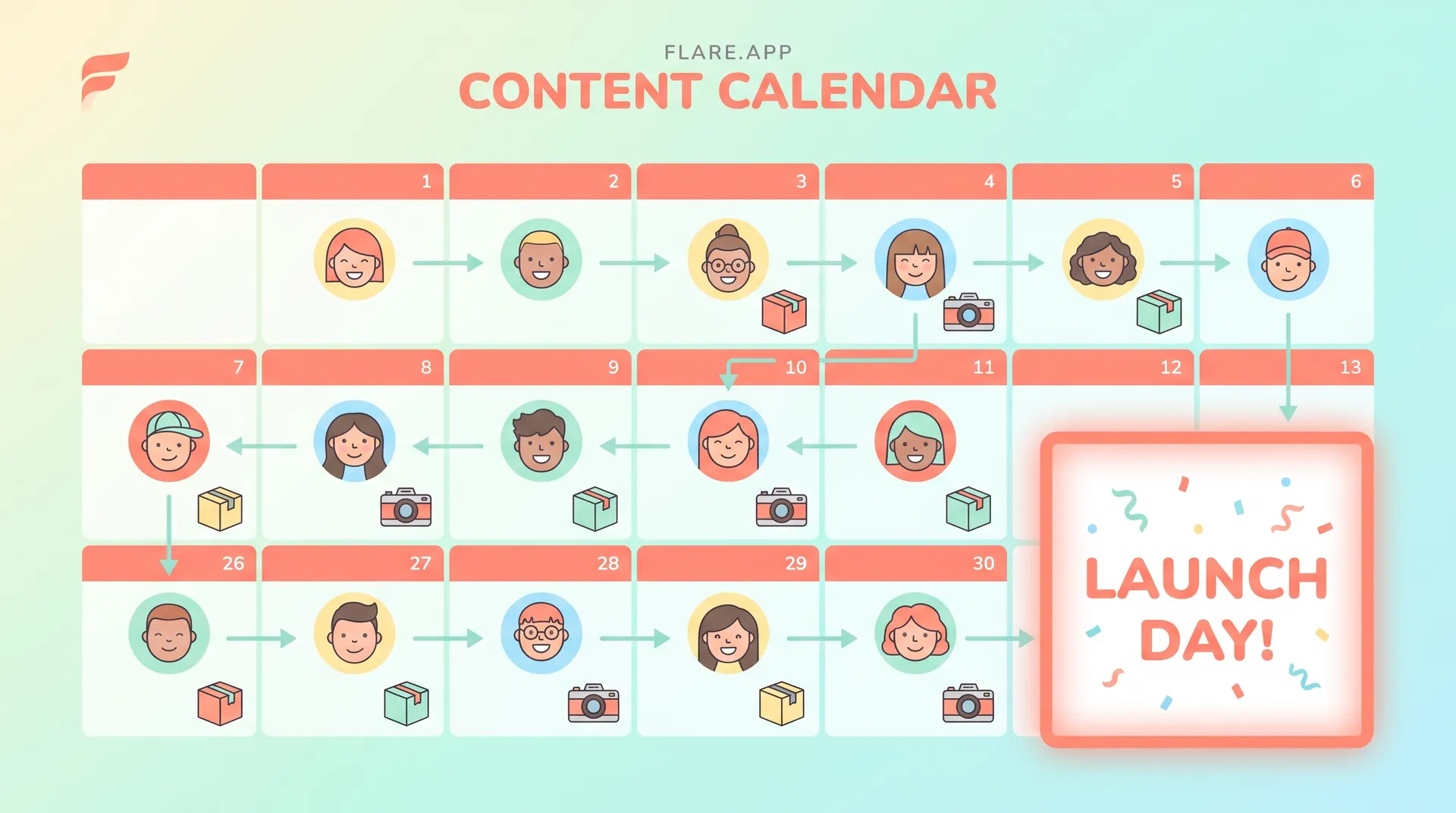
The mistake I see most often: brands ask every creator to deliver on the same day. Then everything shows up at once, nobody has time to review it properly, and half of it gets rushed through approval with no real quality check.
Stagger your delivery windows instead. If you're working with 20 creators, split them into four waves of five, each with a delivery deadline three to four days apart, all landing before your embargo lock date. This gives your team breathing room to review, request revisions, and reject anything that doesn't hit the mark — without a last-minute scramble.
It also gives you something more valuable: a rolling pool of content you can start testing quietly on other assets (non-branded pages, small ad tests to look-alike audiences) before launch day, without breaking embargo. You're not publishing it. You're pressure-testing it.
Stacking Content for Launch-Week Ad Inventory
This is the part brands leave the most money on the table with. You've done the work to get 15-20 pieces of creator content approved and embargoed. Launch day arrives. And then the brand runs... one ad. Maybe two.
Treat your pre-launch UGC library as ad inventory, not just organic posts. Here's how I stack it:
- Segment by angle, not by creator. Group content by the hook or pain point it addresses — price objection, "does this actually work," comparison to what they used before, unboxing satisfaction. You want 3-4 pieces per angle minimum.
- Launch with a spread, not a single winner. You don't know which creative wins yet. Run 6-8 different pieces simultaneously across ad sets on day one, split by angle, and let spend data tell you which one to scale by day three.
- Hold content back for weeks two and three. Don't burn your entire library in the first 72 hours. Creative fatigue sets in fast on new ad accounts. Stagger releases so you have fresh assets when the first wave starts to flatten.
- Pair organic and paid simultaneously. The same piece of content performing organically as a comment-magnet also makes a good ad. Don't treat these as separate libraries — cross-pollinate.
Our guide on UGC ad creative testing goes deeper into how to structure this kind of angle-based testing once your content is live in ad accounts. And if you're mapping this content against different stages of the customer journey, UGC ecommerce strategy is worth a read too.
A launch with 8 pieces of tested creative outperforms a launch with 1 "perfect" hero video almost every time. Volume plus variety beats polish plus guesswork, especially in a window where you have zero performance data to lean on.
Budgeting for the Pre-Launch Push
Gifting product isn't free, and neither is the coordination overhead of managing 20-30 creators on a tight embargo. Build this into your launch budget as a distinct line item, not an afterthought pulled from whatever's left over. If you're unsure how much to set aside, our breakdown on UGC marketing budget planning gives some real benchmarks by brand size and campaign scope.
I'd rather see a brand spend $8,000 on product and modest creator fees to walk into launch day with 20 pieces of tested, embargoed content than spend $50,000 on a single hero ad and hope it lands cold.
FAQ
Frequently Asked Questions
How early should I start seeding UGC creators before a product launch?
What is an embargo brief in UGC marketing?
How many creators should I gift product to for a launch?
Should I run all my UGC content on launch day?
Can creator content be used as paid ads on launch day?
How is a product launch UGC brief different from a regular UGC brief?
Related reading
- UGC marketing: the brand's complete guide (2025)
- UGC creator platforms: best marketplaces for brands
- How to write a UGC campaign brief that works
- UGC ad creative testing: how to find winners fast
- UGC marketing budget: how much brands should spend
- UGC ecommerce strategy: map content to every funnel stage
For more on the mechanics of vetting and briefing creators at scale, check out Meta's guidance on branded content, TikTok's Creator Marketplace resources, and Nielsen's research on consumer trust in user-generated content.