Landing Page Copywriting for SaaS That Works Without Video
Landing page copywriting for SaaS shouldn't depend on video playing. Learn how to write headlines and subheads that sell your offer on their own.

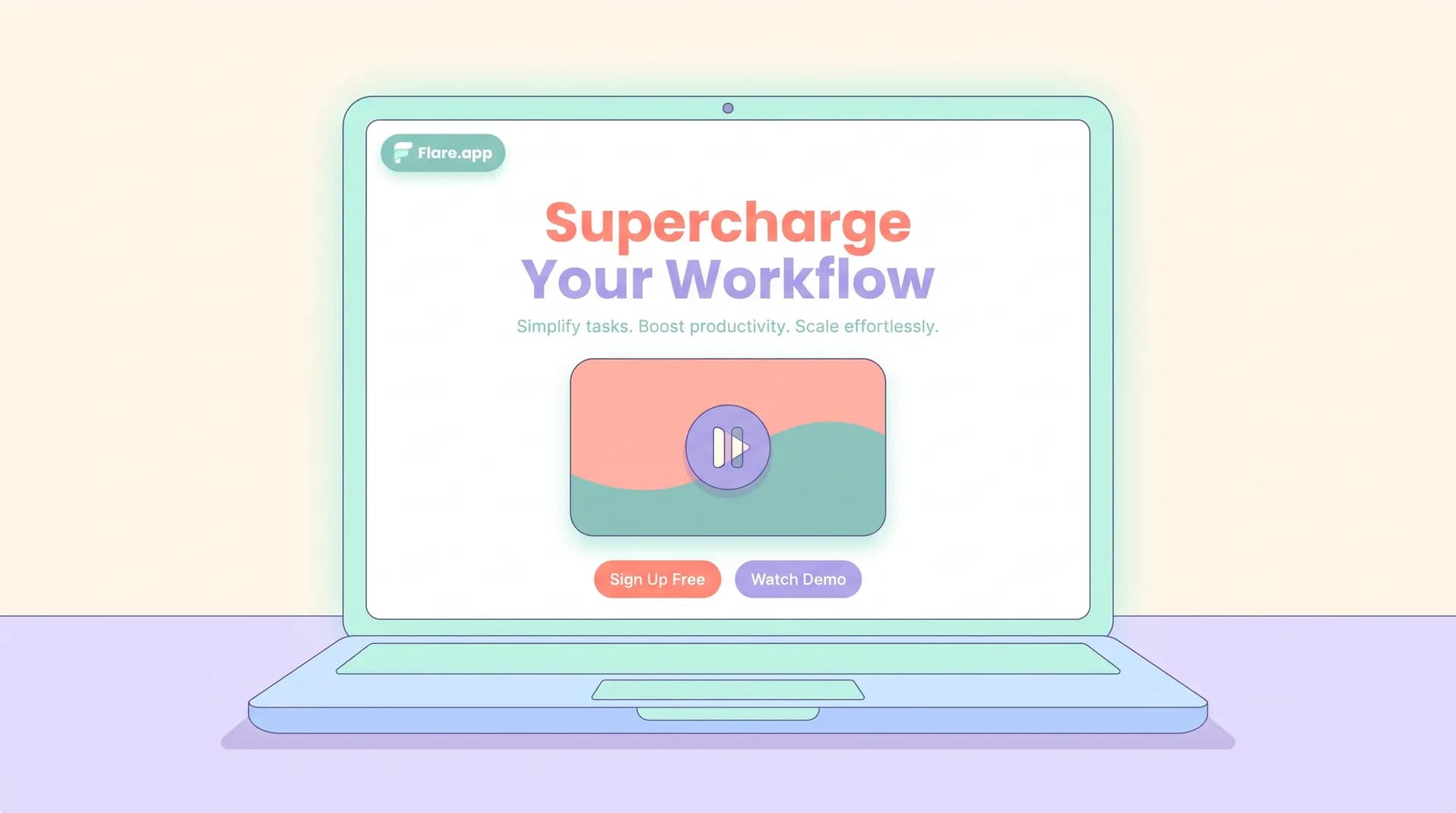
Pull the video off your landing page right now. Mentally, I mean. Don't actually delete it. Now look at what's left: a headline, a subhead, maybe three bullet points, and a button. If that alone doesn't make someone understand what you sell and want to click, your video isn't fixing the problem. It's hiding it.
I've watched this happen on dozens of SaaS pages I've reviewed for Flare customers and for my own product. Founders spend three weeks and $4,000 on a slick explainer video, slap it above the fold, and conversion barely moves. Then we check the session recordings and almost half the visitors never hit play. They skim the headline, glance at the video thumbnail like it's wallpaper, and bounce or scroll. The copy was carrying zero weight, and copy that carries zero weight loses you the visitor before the video even gets a chance.
Landing page copywriting for SaaS can't lean on video to do the explaining
Video is persuasion. Copy is comprehension. Those are different jobs and you need both, but only one of them is mandatory for every single visitor.
Think about where your traffic actually comes from. Paid social scrollers on 3G connections. People in open-plan offices with sound off. Screen readers for accessibility. Slow-loading embeds on an old company wifi. Every one of those visitors hits your page and sees text before — or instead of — video. If your headline is "See it in action" with a subhead that says "Watch how it works," you've told them nothing. You're asking for a 90-second investment before you've earned ten seconds of their trust.
I made this exact mistake with an early version of Flare's own homepage. The hero said "Content that converts" over a video of creators filming UGC. Sounded nice. Said nothing. We swapped it for "Get paid, on-brand UGC videos in 72 hours — no agency, no guesswork" and conversion on that page section jumped noticeably within the first week, before we touched the video at all. The video didn't get better. The copy started doing its job.
This is really the same principle behind the pillar piece we wrote on SaaS landing page conversion and matching promise, video, and CTA — the video, headline, and button all need to tell the same story, and the copy has to be able to tell that story solo.
The three jobs your headline and subhead must do alone
Your core copy, without any help from video, needs to answer three questions in under five seconds:
- What is this product?
- Who is it for?
- What happens after I click the button?
Not "why is it great." Not "how innovative is the technology." Just those three. Most SaaS headlines fail because they're emotional taglines borrowed from a brand deck, not functional sentences that explain an offer. "The future of team collaboration" fails all three questions. "Project management for 5-person agencies — plan a sprint in 10 minutes" passes all three.
Write your headline as if the video embed is broken. Because for a meaningful slice of your traffic, functionally, it is.
How to write headline and subhead copy that stands on its own
Start with the subhead, not the headline. I know that's backwards from how most people draft, but hear me out. The subhead is where the proof and specificity live — the headline is the hook. If you write the subhead first, you're forced to nail down the actual mechanism of your product before you try to make it sound exciting.
Headline formula that works for most SaaS pages:
[Outcome] for [specific audience] — without [the thing they hate doing]
Examples:
- "Customer onboarding emails for SaaS teams — without writing a single one from scratch"
- "Invoice tracking for freelance designers — without spreadsheets"
Subhead formula:
[How it works in one clause] + [proof point or number]
Examples:
- "Flare matches you with vetted creators and delivers edited UGC in 72 hours. Over 1,200 SaaS teams use it to launch ad creative weekly."
- "Set up in 15 minutes. No credit card, no sales call required."
Notice neither of those sentences references the video at all. They don't need to. The video, when it does play, reinforces what the copy already promised — it doesn't introduce new information the copy was too lazy to include.
A few more rules I hold my own copy to:
- No jargon that requires context. If a word needs the video to be understood ("see our AI-powered workflow engine in action"), it's a red flag. Say what the engine does.
- Numbers beat adjectives. "Fast" is a claim. "72 hours" is a fact. Facts survive without a video explaining them.
- One idea per headline. If you're cramming two benefits into one sentence, you've written a headline for a video script, not a landing page.
- Read it out loud with your hand over the video thumbnail. If it still makes sense and makes you want to know more, it's doing its job.
Try the "sound-off, video-off" test before you ship any landing page redesign: screenshot the page, crop out the video entirely, and show the screenshot to someone unfamiliar with your product. Give them 5 seconds. Ask them to explain what the company does. If they can't, your copy needs work regardless of how good the video is.
Where video actually earns its place
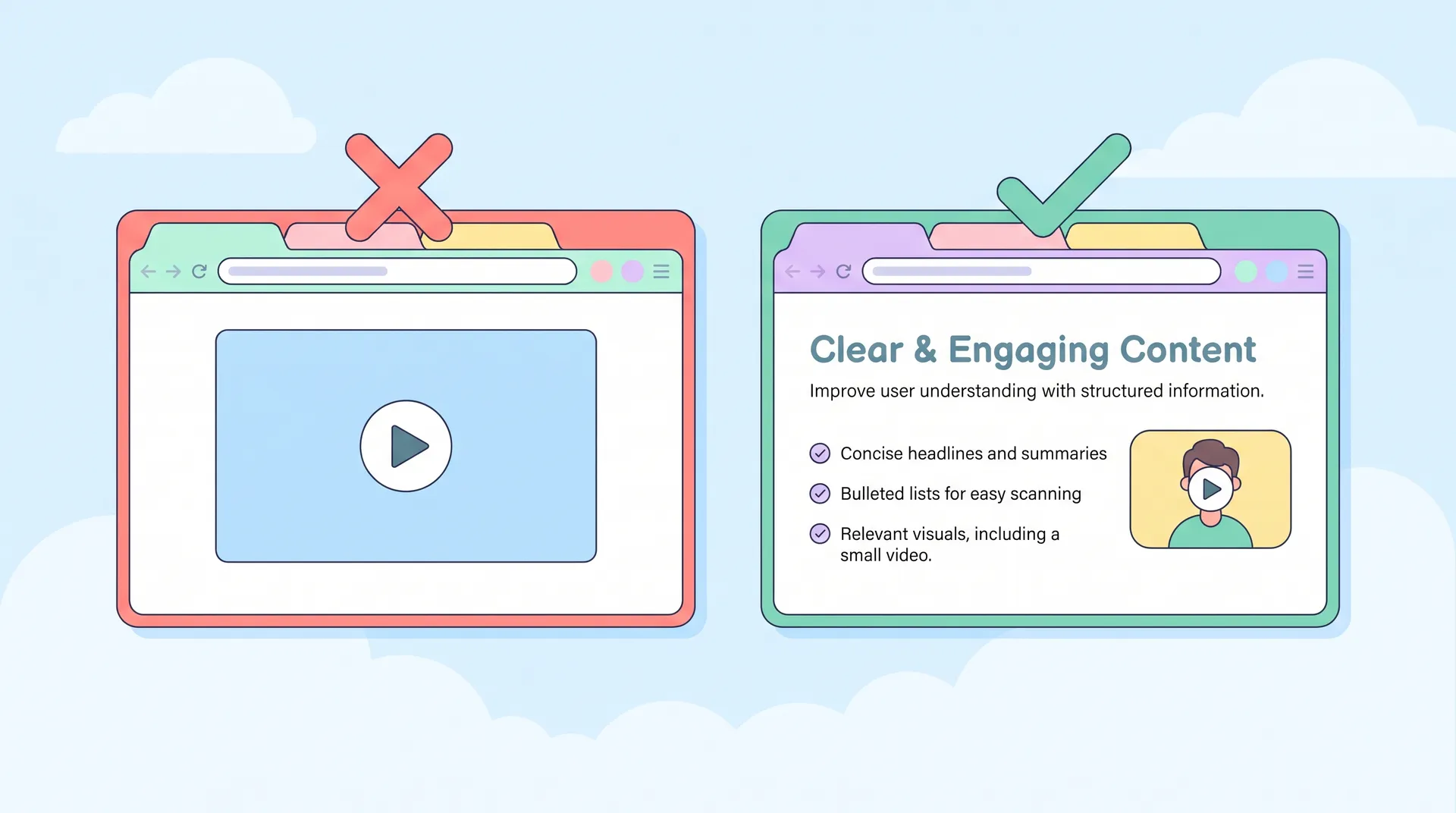
None of this means cut the video. Video is still one of the best tools you have for building trust fast — faces, voices, and demos do things text can't. I've written before about where to place video on your SaaS landing page and the short version is: video works best near the CTA, as a confidence booster right before someone commits, not as the explainer that does the heavy lifting up top.
Think of the hierarchy like this:
- Copy establishes what the offer is (must work with zero video plays)
- Video builds trust and shows proof (works when copy has already earned attention)
- CTA converts the interest copy and video built together
If you get the order backwards — relying on video to establish the offer, then using copy as decoration underneath — you lose everyone who doesn't press play. Wistia's own benchmark data shows average landing page video play rates hover well under 50% on most SaaS pages, which means you're writing off more than half your audience if your copy can't stand alone (source: Wistia State of Video Report).
This also connects to a mistake I covered in why SaaS landing page examples fail on message match — when the ad promises one thing and the page copy says something vaguer, visitors don't wait around for the video to clarify. They just leave. Copy needs to match the promise instantly, with or without the video loading.
What this looks like for different page goals
Not every SaaS page is selling the same action, and your copy needs to flex accordingly. If you're sending people to a free trial versus a demo call, the clarity bar for your headline changes — I go deeper on this in trial signup vs demo request landing page best practices, but the short version is that demo-request pages need copy that qualifies the visitor (so sales doesn't waste time), while trial pages need copy that removes friction immediately.
Either way, the test stays the same: cover the video, read the copy, see if it stands up.
A quick audit you can run today
Pull up your current landing page. Do this in five minutes:
- Scroll to your hero section and read only the headline and subhead out loud.
- Ask: does this explain the product, audience, and outcome without inference?
- Check your bullet points below the fold — do they repeat what the video says, or add new specific details?
- Look at your CTA button copy. Does it say "Submit" or does it say something tied to the outcome, like "Start my free trial"?
- Disable images and video in your browser (most browsers let you do this in dev tools) and reload the page. What's left? Is it still a pitch, or is it just white space and a logo?
I run this audit on every landing page redesign now, video included or not, because copy weak enough to need a video crutch is usually weak everywhere else too — in your ads, your emails, your onboarding flow. Fixing it at the landing page level has a way of sharpening your messaging company-wide.
HubSpot's research on landing page optimization consistently shows that clarity of value proposition in text correlates more strongly with conversion lift than media richness alone — richer pages convert better only when the underlying message is already clear (source: HubSpot Marketing Statistics).
Video production itself matters too, obviously — if you're still figuring out what to film in the first place, our guide on planning and producing a SaaS demo video that sells walks through that separately. But production quality is a secondary problem. Fix the copy first.
FAQ
Frequently Asked Questions
Should a SaaS landing page headline mention the video?
What's the ideal length for a SaaS landing page headline?
Does removing video hurt SaaS landing page conversion?
How do I test if my landing page copy works without video?
What's the difference between a headline and a subhead on a SaaS page?
Where should video go if not in the hero section?
Related reading
- SaaS landing page conversion: matching promise, video, CTA
- Where to Place Video on Your SaaS Landing Page Design
- Message Match: Why Your SaaS Landing Page Examples Fail
- Landing Page Video Thumbnail: Win Visitors Who Never Click Play
- Trial Signup vs Demo Request: SaaS Landing Page Best Practices
- Demo vs Founder vs Testimonial Video Landing Page Picks