
Marketing Funnel for SaaS Founders: Count Conversations
A marketing funnel for SaaS founders should track qualified conversations and signups, not views. Here's the exact framework I use at Flare.

I once spent three months posting daily on LinkedIn, hit 40,000 impressions on my best video, and closed zero customers from it. Meanwhile, a single reply to a comment turned into a 20-minute call that turned into our eighth paying account. That's when I stopped caring about reach and started building an actual marketing funnel for SaaS founders — one measured in conversations, not views.
Most founders doing their own marketing fall into the same trap I did. You post something, it gets traction, the notifications feel good, and you convince yourself that's progress. It's not. Impressions are a vanity layer sitting on top of the thing that actually matters: did a real human with a real problem talk to you about it?
Why the marketing funnel for SaaS founders breaks on vanity metrics
Views are easy to get and easy to game. Post a hot take, add a controversial hook, ride an algorithm wave — you'll get numbers. None of that tells you whether your ideal customer saw it, understood it, or cared enough to act.
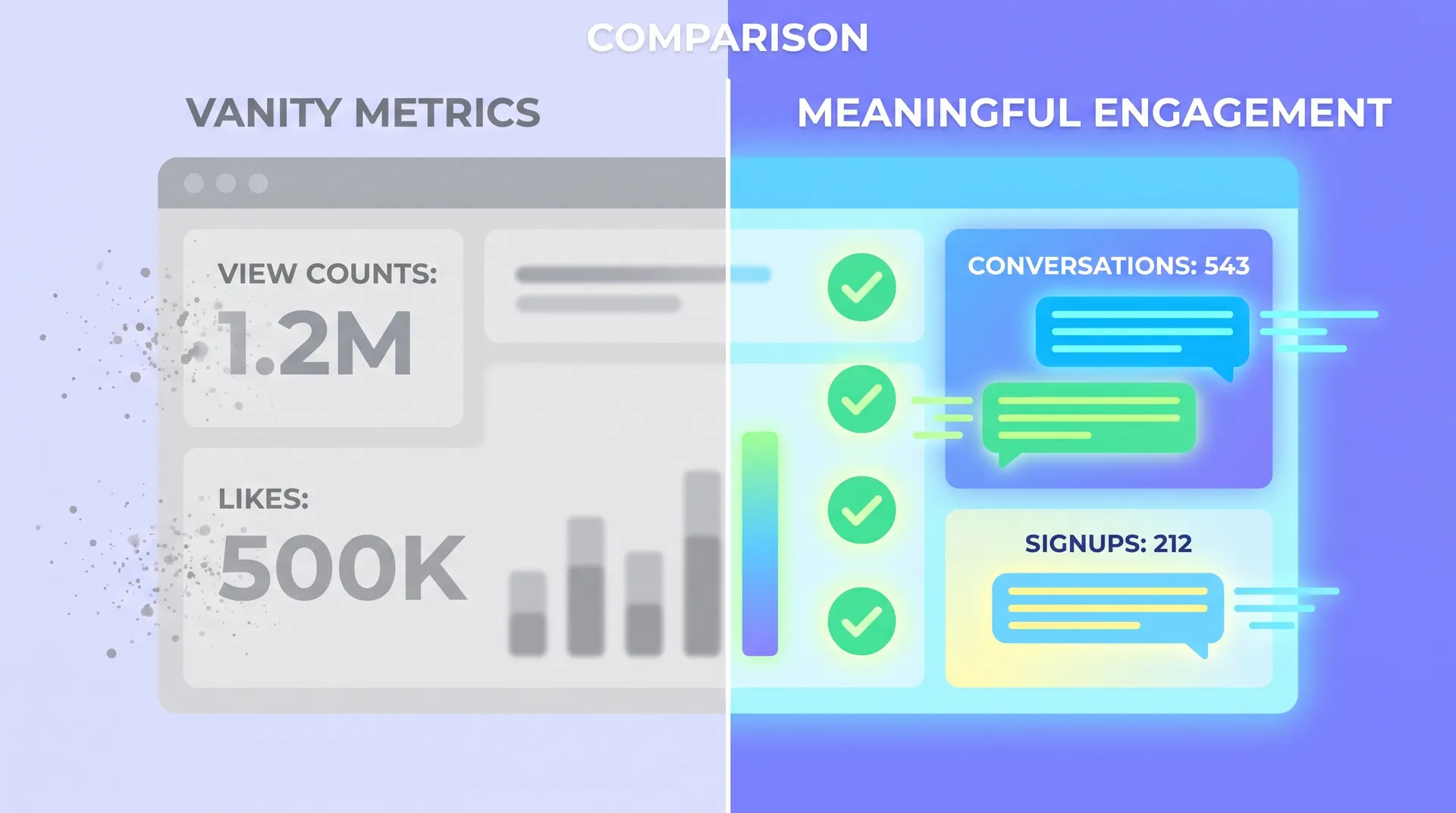
I've watched founders celebrate a video hitting 100K views while their signup count that week didn't move. The math doesn't work because the metric was never connected to the goal. A view is attention. A conversation is intent. Those are different species of data, and only one of them pays your bills.
Here's the blunt version: if you can't trace a metric to a reply, a DM, a comment that turns into a thread, or a signup, it's noise. I'm not saying ignore reach entirely — you need some of it to generate conversations in the first place. But reach is an input, not an output. Treating it as the scoreboard is how founders burn a year posting content that never moves revenue.
This is the same mistake I see in creator campaigns for apps, where teams chase view counts instead of completed in-app actions. The fix is identical whether you're running founder content or paid UGC: define the downstream action first, then work backward.
The three layers that actually matter
I think about founder-led marketing in three layers, and only the bottom two show up in a healthy funnel report:
- Reach — impressions, views, followers. Necessary fuel, not a result.
- Engagement that signals intent — comments asking a real question, saves, shares with a personal note, DMs.
- Conversations and signups — a reply thread that turns into a call, a demo request, a trial signup, a "can you tell me more about pricing" message.
Layer three is where you build your funnel. Everything above it is context.
Building your actual funnel: from post to paying customer
A marketing funnel for SaaS founders needs five stages, and each one has to have a number attached to it that you check weekly. Not monthly. Weekly, because founder-led channels move fast and you need to catch dead stages before you've wasted a quarter.
Stage 1 — Content published. How many posts, videos, or replies did you put out. This is your only input metric that isn't an outcome.
Stage 2 — Qualified engagement. Not likes. Comments from people who look like your ICP, DMs, profile visits from people who then visit your site. I tag these manually in a spreadsheet for the first few months because no tool does this well out of the box.
Stage 3 — Conversations started. Someone replies with a question, books time, or messages you directly. This is the number I check obsessively. If this number is flat while reach is climbing, your content is entertaining, not persuasive.
Stage 4 — Qualified signups or demo requests. Did the conversation turn into someone trying the product. I wrote a deeper breakdown of this exact handoff in Measuring Qualified Demo Requests From Creator Campaigns — the same logic applies whether the conversation started with a creator or with you personally.
Stage 5 — Activated or paying customer. Did they actually use the thing, or did they sign up and vanish. This connects straight back to onboarding, which is its own measurement problem — I cover that in Saas Onboarding Activation Metrics: Stop Counting Views.
Five stages, five numbers, checked weekly. That's the whole system. No dashboard software required for the first six months — a spreadsheet with dates and tags gets you further than people think.
Tagging conversations so you can actually report on them
The part everyone skips: tag every conversation by source. When someone DMs you after a LinkedIn post, write down the post. When a reply thread on a comment turns into a call, note which comment started it. After eight weeks you'll see patterns — certain formats (customer story posts, sales-objection breakdowns, raw screen recordings) generate 3-5x more conversations than others, even with lower view counts.
This is exactly the insight that shaped how I think about handling objections in sales video — the posts that address a specific, named objection convert conversations at a much higher rate than general "here's our product" content, even though they often get fewer views.
Create a simple tag system: source (platform + post), stage (engaged, conversation, signup, customer), and date. Even a basic spreadsheet beats guessing, and you'll spot your highest-converting content format within a month.
What to actually track in your SaaS marketing funnel
Forget vanity dashboards. Here's the exact weekly scorecard I use:
- Conversations started per week — the core leading indicator
- Conversation-to-signup rate — if this craters, your pitch in conversation is broken, not your content
- Signup-to-activation rate — tells you if marketing is bringing in the right people
- Source tagging — which content format, platform, and topic drove each conversation
- Time from first touch to conversation — some posts convert same-day, others take three weeks of someone lurking before they reach out. Both are fine, but you need to know the lag so you don't panic and kill a channel too early
Notice reach and impressions aren't on this list at all. They exist as a diagnostic — if conversations are flat and reach is also flat, you have a distribution problem. If reach is strong but conversations are flat, you have a message problem. That diagnostic use is the only job vanity metrics should have.
I built this approach into how I think about marketing channels for SaaS companies generally — pick the channel based on where qualified conversations actually originate, not where the algorithm is currently rewarding you.
A real example from Flare
When we launched Flare's creator marketplace features, I posted a screen recording of me manually matching a brand brief to creators — ugly, unscripted, 90 seconds long. It got maybe 2,000 views, a fraction of our best-performing posts. But it generated 11 DMs in 48 hours, and four of those turned into demo calls. Compare that to a slick, scripted brand video that hit 18,000 views and generated two DMs, neither of which converted.
If I'd only tracked views, I'd have doubled down on the slick video format and starved the thing that was actually working. This is the core argument in our pillar guide to founder-led marketing — the whole program only works if you're measuring the right layer of the funnel from day one.
Don't let a single viral post convince you that format is "the answer." Check whether it generated conversations, not just views, before you rebuild your content calendar around it.
Setting up reporting that doesn't lie to you
Build a simple weekly report with three sections: conversations started (with source tags), conversion rate to signup, and one qualitative note — what did people actually ask you this week. That qualitative layer matters more than people admit. If five people ask the same question in DMs, that's your next piece of content, not a coincidence.
Resist the urge to build this in a fancy BI tool immediately. A shared spreadsheet that you and your team update every Friday for 15 minutes will outperform an automated dashboard nobody trusts. Add automation once you know which numbers actually predict revenue — not before.
For benchmarking, HubSpot's research on content marketing ROI and conversion still underscores that engagement quality (comments, replies) predicts pipeline better than reach at nearly every B2B company they've studied. Similarly, data from First Round Review's founder surveys consistently shows that founder-initiated conversations close at a dramatically higher rate than inbound form fills, simply because the trust is pre-built. And OpenView's SaaS benchmarking reports have shown for years that top-of-funnel vanity metrics correlate weakly with actual net new ARR when isolated from conversation and demo data.
Don't let the algorithm set your KPIs
Platforms want you optimizing for watch time and reach because that's what keeps you posting more, which keeps them profitable. Your job as a founder is different: you need revenue, not platform engagement. Every time you catch yourself checking view counts before checking your DMs, you're letting someone else's incentive structure run your business.
Build the five-stage funnel, tag your conversations, check it weekly, and give yourself permission to kill content formats that rack up views but never start a conversation. That discipline is the entire difference between founder-led marketing that compounds into a real pipeline and founder-led marketing that just feels busy.