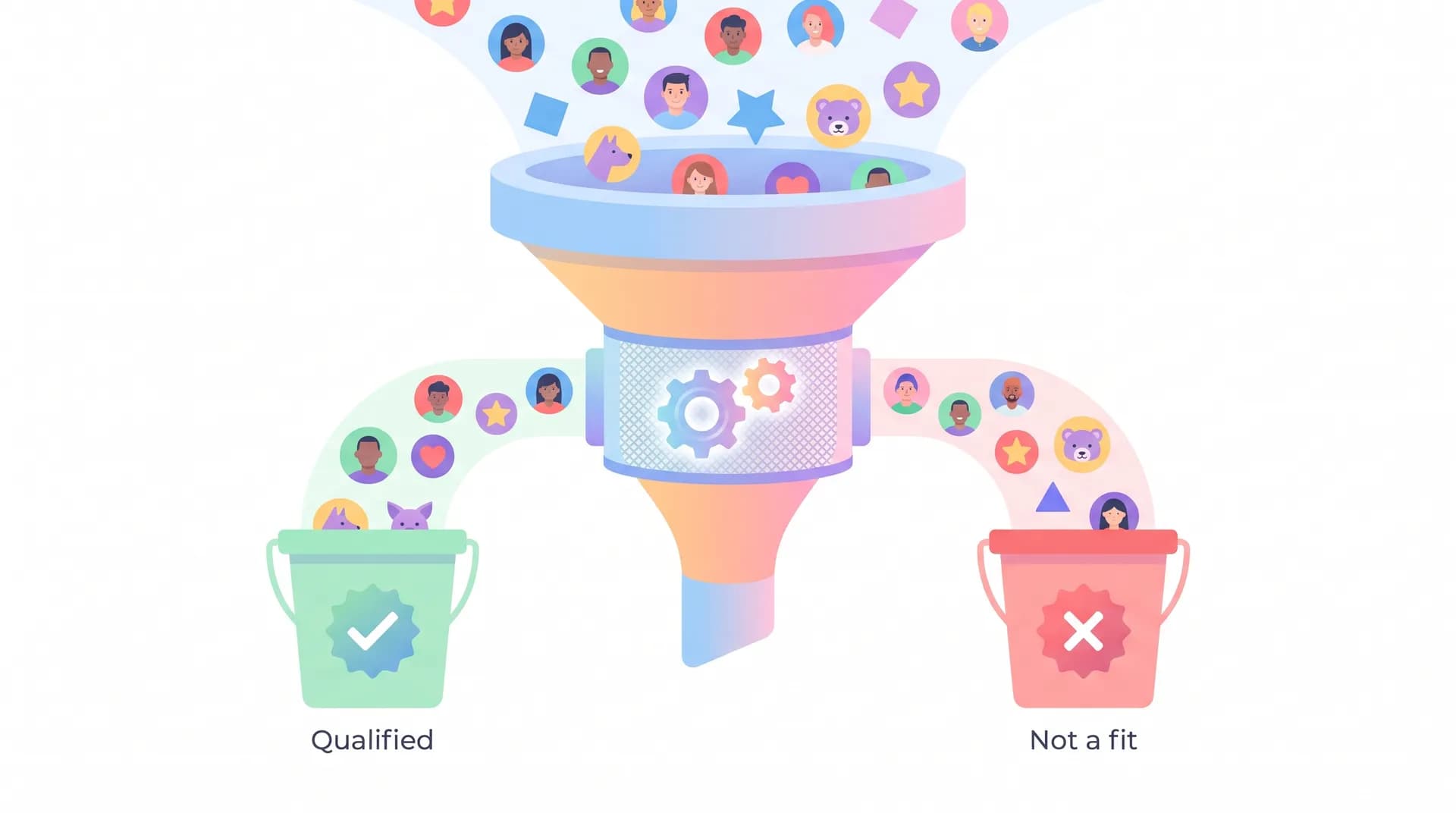
Measuring Qualified Demo Requests From Creator Campaigns
Learn how to track qualified demo requests from a creator campaign against ICP criteria, not just raw volume, so you can prove real pipeline impact.

Last quarter a creator campaign drove 340 demo requests. Leadership was thrilled — until Sales flagged that 290 of them were students, job seekers practicing cold outreach, and people who just wanted the free trial gift card mentioned in the video. Nine demos actually closed. That gap between "demo requests" and "qualified demo requests creator campaign" tracking is where most B2B creator programs quietly fail, and almost nobody sets up the tracking to catch it before the quarterly review turns ugly.
I've run this exact postmortem more times than I'd like to admit. A creator posts a walkthrough, the form fills up, everyone celebrates in Slack, and then three weeks later an AE tells you half the "leads" listed their job title as "N/A" and their company as "self." The content worked. The targeting didn't. And if you're only counting form fills, you can't tell the difference.
Why raw demo request counts lie to you
A demo request number by itself tells you almost nothing about whether a creator campaign is working. It tells you a form got submitted. That's it.
Creator content, especially the kind that performs well on YouTube or LinkedIn, tends to pull a wider audience than a paid search ad targeted by job title and company size. People watch because the creator is credible or entertaining, not because they're mid-evaluation for a $50K software purchase. Some of them click through out of curiosity. Some are researchers, competitors, students, or just people who like watching smart people explain software.
None of that makes the creator bad at their job. It makes raw volume the wrong metric.
I've seen teams kill creator partnerships because "the demo requests were low quality," when the real issue was they never defined what quality meant before launch. You can't qualify against a standard that doesn't exist. If your sales team is manually eyeballing a spreadsheet to decide who's "real," you're already behind — you need qualification criteria baked into the form and the routing logic before a single piece of content goes live.
The volume trap in practice
Picture two campaigns. Campaign A generates 50 demo requests, 35 of which match your ICP. Campaign B generates 400 demo requests, 20 of which match. By every vanity metric, B wins. By every metric that pays your bills, A wins by a mile.
If you're reporting campaign performance by total demo volume, you're structurally biased toward content that reaches the widest, least-targeted audience — which is usually the opposite of what makes a creator partnership valuable in B2B. This is one reason I keep coming back to the ideas in our pillar piece on B2B influencer marketing: the whole point of working with creators who have real practitioner credibility is that their audience skews toward people who actually do the job your software supports. If you're not measuring for that, you're throwing away the one advantage creator partnerships have over a generic ad network.
Setting up ICP qualification before launch
You need three things in place before the first creator video goes live: a defined ICP, a tagging mechanism on the form, and routing logic that separates signal from noise automatically.
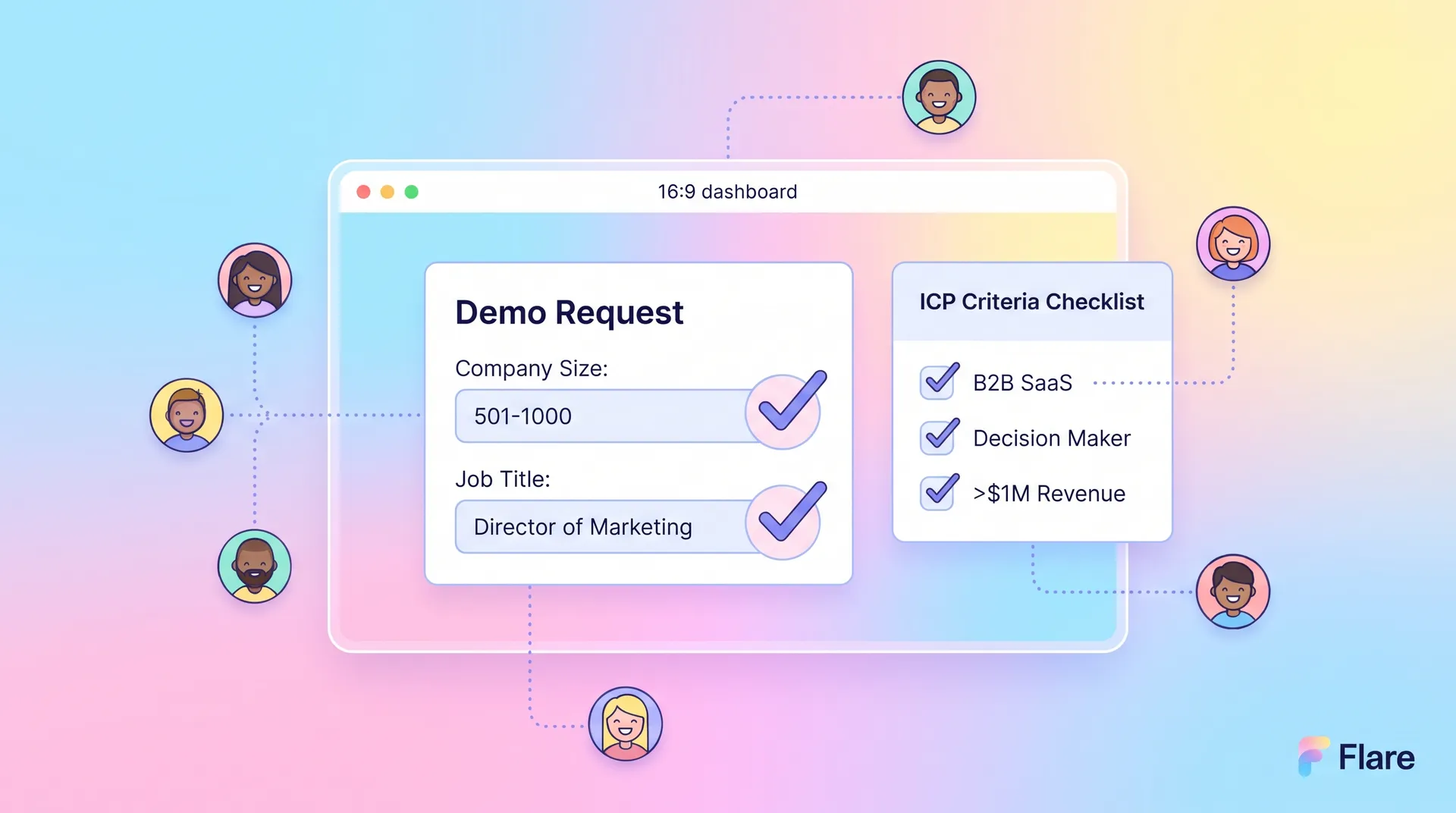
Define your ICP in form-fillable terms. Not "mid-market companies that value efficiency." That's not a filter, that's a vibe. You need fields a form can actually validate: company size range, job title or seniority, industry, and sometimes tech stack. If your ICP is "RevOps leaders at companies with 50-500 employees using Salesforce," build a form that captures exactly those four data points, not a generic "tell us about your company" textbox nobody fills in honestly.
Add a dedicated UTM structure for each creator and each piece of content. This sounds basic, but I still see teams running creator campaigns with a single generic UTM like utm_source=youtube. That tells you nothing when you have four creators posting in the same month. Use utm_source=creator, utm_medium=[platform], utm_campaign=[creator-name]_[content-id]. Every single demo request should trace back to the exact video and creator that drove it, not just the platform.
Build qualification logic into your CRM or marketing automation tool, not a human doing it after the fact. Most tools — HubSpot, Marketo, Salesforce — support lead scoring rules that can auto-tag a submission as qualified or unqualified based on the form fields plus firmographic enrichment (tools like Clearbit or ZoomInfo can append company size and industry automatically if the person doesn't self-report it). This matters because self-reported data is unreliable; people fat-finger job titles or pick "Other" to get through the form faster.
Set up a "fit score" that combines explicit form data with enriched firmographic data. A lead who says "VP of Sales" but whose enriched data shows a 12-person company probably isn't your ICP, even if the title looks right on paper.
If you've already gone through the work of vetting creators for product knowledge, apply the same rigor to the leads they generate. A great creator with the wrong audience will produce exactly what happened in my opening example — lots of noise, almost no signal.
What qualified actually means, stage by stage
"Qualified" isn't a single gate. I think about it in three layers, and conflating them is how teams end up arguing about whose fault a bad quarter was.
- Form-qualified — the submission matches your stated ICP fields (right title, right company size, right industry). This is the cheapest check and should happen instantly, automatically, no human involved.
- Sales-accepted — an AE or SDR reviews the lead and confirms there's a real buying motion: budget exists, there's a problem being solved, timing makes sense. This takes human judgment and usually happens within 24-48 hours of the demo request.
- Sales-qualified — the prospect has been through a discovery call and meets BANT or MEDDIC criteria, whatever framework your sales org actually uses.
Most creator campaign reports I see stop at raw volume and never even reach layer one. If you report "qualified demo requests" without specifying which of these three stages you mean, you're setting yourself up for a fight with Sales six weeks later when the numbers don't reconcile.
Track all three stages separately for every creator and campaign. The conversion rate between stage one and stage two tells you if your form qualification criteria are actually predictive. The conversion rate between stage two and stage three tells you if the leads that look good on paper are actually serious buyers. If your form-qualified rate is high but your sales-accepted rate is low, your ICP criteria are too loose or your enrichment data is stale.
Attribution gets messy — plan for it
B2B buying cycles are long, and creator content rarely closes the deal on first touch. Someone watches a creator's walkthrough in March, forgets about it, gets reminded by a coworker in June, and finally requests a demo in August after seeing a retargeting ad. First-touch attribution would credit the creator; last-touch would credit the ad.
I'm not going to pretend there's a clean answer here. What I'd push you to do is run multi-touch attribution if your stack supports it (HubSpot and Salesforce both have options, and tools like Dreamdata or HockeyStack specialize in this for B2B specifically), and at minimum track creator content as an influenced touch even when it's not the last click before the form fill. If you only count last-touch, creator partnerships will always look worse than they are, because awareness content almost never gets the final click.
This connects directly to how you should think about choosing the right voice for your B2B content — a creator video early in the funnel is doing a different job than a demo request form at the bottom, and your attribution model needs to respect that difference instead of flattening everything into last-click credit.
Reporting it so Sales and leadership actually trust it
Don't hand your VP of Sales a dashboard with one number labeled "qualified leads from creators." Build a report that shows, per creator and per piece of content: total demo requests, form-qualified rate, sales-accepted rate, and if you have enough volume, closed-won rate and pipeline value generated.
This level of detail does two things. It protects good creator partnerships from getting cut because of a surface-level volume comparison, and it gives you the evidence to cut the ones that actually aren't working — which is just as important. I've kept creators on retainer for too long because the top-line number looked fine, when a deeper look would've shown their audience almost never converted past stage one.
If you're building a roster of creators for ongoing partnerships, this reporting discipline becomes even more valuable over time — it's how you decide who to renew and who to let go, which ties directly into building out an ongoing roster of B2B creators worth scaling instead of a rotating cast of one-off deals that never compound.
Don't wait until your renewal conversation with a creator to build this tracking. Set it up before the first campaign launches — retroactively reconstructing attribution data from a messy CRM is painful and usually incomplete.
A simple framework to steal
If you don't have anything in place yet, here's the minimum viable setup I'd tell a founder to build this week:
- Unique UTM per creator and content piece
- Form fields that map directly to your ICP (title, company size, industry — no more than 4 fields, people abandon longer forms)
- Automated lead scoring in your CRM that tags form-qualified vs. not, instantly
- A weekly pull (not monthly — creator content moves fast) showing demo requests by creator broken into the three qualification stages
- A shared doc or Slack channel where Sales flags obviously bad leads with a reason, so you can tighten your criteria over time
None of this requires enterprise tooling. A HubSpot form with conditional logic and a Zapier connection to Slack can get you 80% of the way there for most early-stage teams.