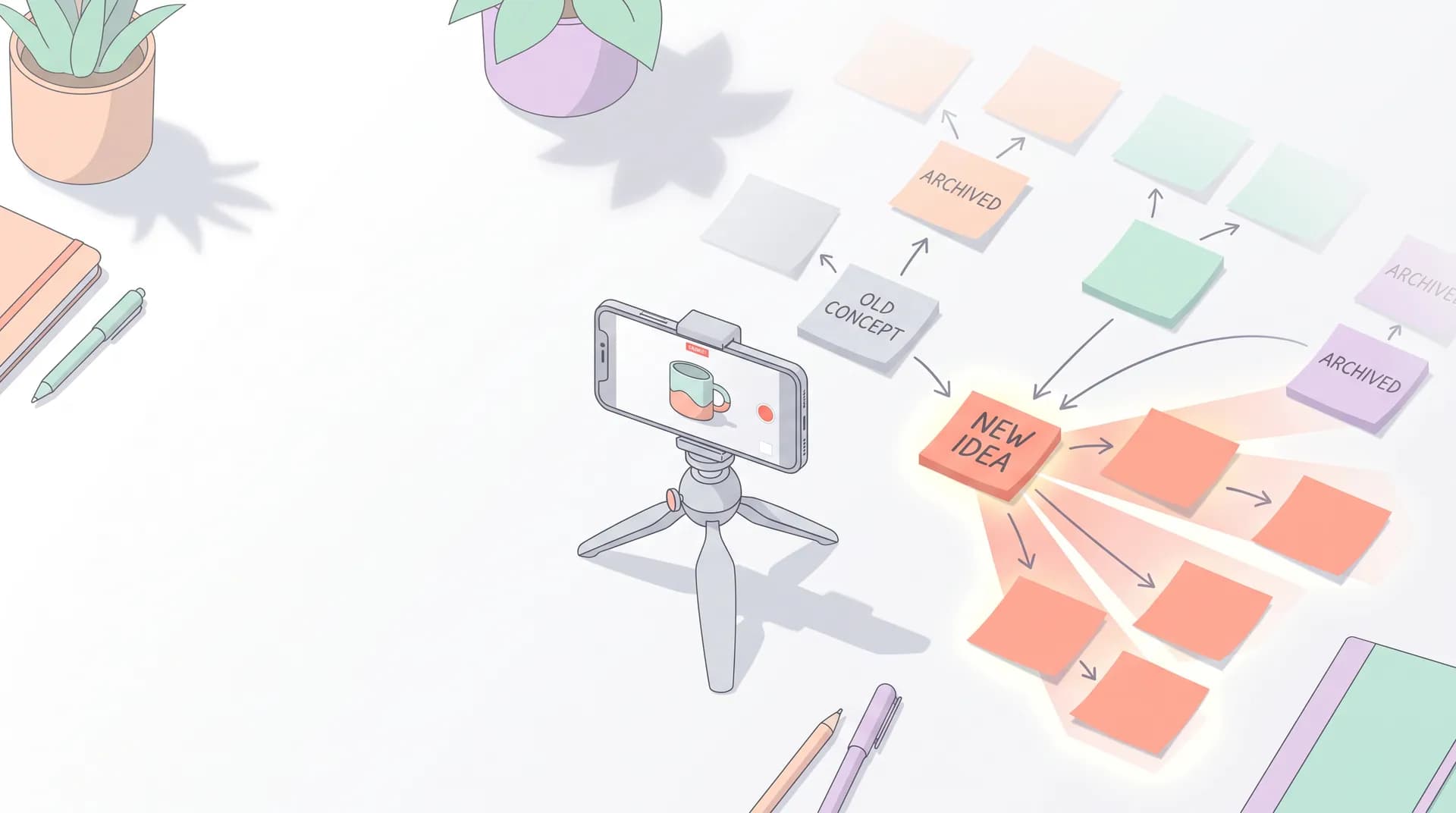
How to Build a UGC Ad Creative Iteration System That Scales
Stop restarting from scratch. Build a UGC ad creative testing and iteration system that finds winners fast and scales them without burning your budget.

Last year I watched a brand burn $14,000 on one "perfect" UGC ad. Beautiful creator. Great hook. Fully approved by three stakeholders. It flopped so hard the account's CPM doubled in two weeks.
Meanwhile, a scrappier competitor spent the same $14,000 across eleven rough-cut variants — some filmed on a phone in a kitchen — and found two winners that ran profitably for five months.
The difference wasn't talent. It was process. One brand made an ad. The other ran a system. If you're doing UGC ad creative testing the way most brands still do it — brief one creator, wait two weeks, launch, pray — you're not testing. You're gambling with better lighting.
I've built iteration systems for dozens of performance creative programs now, and I'll tell you exactly how the repeatable version works.
Why most UGC ad creative testing dies after round one
Here's the pattern I see constantly. A brand launches 5-8 UGC ad variants. One outperforms. Everyone celebrates. The winner gets all the budget. Then it fatigues in three weeks, ROAS slides, and the team scrambles back to a blank page.
Round two never happens because round one was never designed to feed it.
That's the core mistake. Testing isn't a phase — it's an engine. Every variant you launch should generate information that makes the next batch cheaper and smarter. When your testing process produces conclusions instead of just winners, you compound. When it produces only winners, you start over every time the algorithm gets bored.
The goal of a UGC creative iteration system isn't finding one winner. It's making every subsequent search for a winner faster and cheaper than the last.
There's also a mindset problem I run into with founders: they treat UGC like a lottery ticket instead of a data stream. One video hits, and they conclude "UGC works." One video misses, and they conclude "UGC doesn't work for our brand." Both conclusions are wrong. With sample sizes this small, you haven't learned anything yet. You've just been surprised.
If you want the full background on how UGC functions inside paid social, start with my complete performance creative guide — this article is the iteration layer that sits on top of it.
The launch phase: ship variants, not ads
Your first batch sets the ceiling for everything after it, so build it for information density, not polish.
One creator, multiple concepts — not one concept, multiple creators
The single biggest efficiency gain in my system: brief one creator to deliver 3-4 distinct concepts in a single shoot instead of paying three creators for one video each. Same day, same lighting setup, same product. You cut production cost per variant by roughly 60% and remove creator performance as a confounding variable. If Concept A wins, you know the concept won. Not the face.
This is exactly why we write ad shoot briefs that specify multiple concepts upfront — retro-fitting "also do two more versions" after delivery never works and annoys good creators.
Vary the angle, not the decoration
A weak test batch varies surface stuff: different outfits, different backgrounds, same message. You'll learn nothing.
Vary the angle of persuasion instead. One concept leads with the problem ("if your coffee tastes burnt, watch this"). One leads with social proof ("I'm the fourth person in my group chat to buy this"). One leads with the objection ("yes, it's $60 — here's why that's actually cheap"). One is a pure demo. If you need help generating distinct hooks fast, our UGC hook A/B testing briefs give you a framework for briefing them without dictating every word.
Volume beats perfection
I want 8-12 live variants minimum per cycle. Below that, the signal-to-noise ratio in your results makes every conclusion shaky. Above roughly 20, your spend per variant gets too thin to read anything — Meta's algorithm needs enough delivery to exit the learning phase per ad.
For most brands spending $3-10K/month, one batch of 10-14 variants every 3-4 weeks is the sweet spot.
Read spend signals before the platform tells you
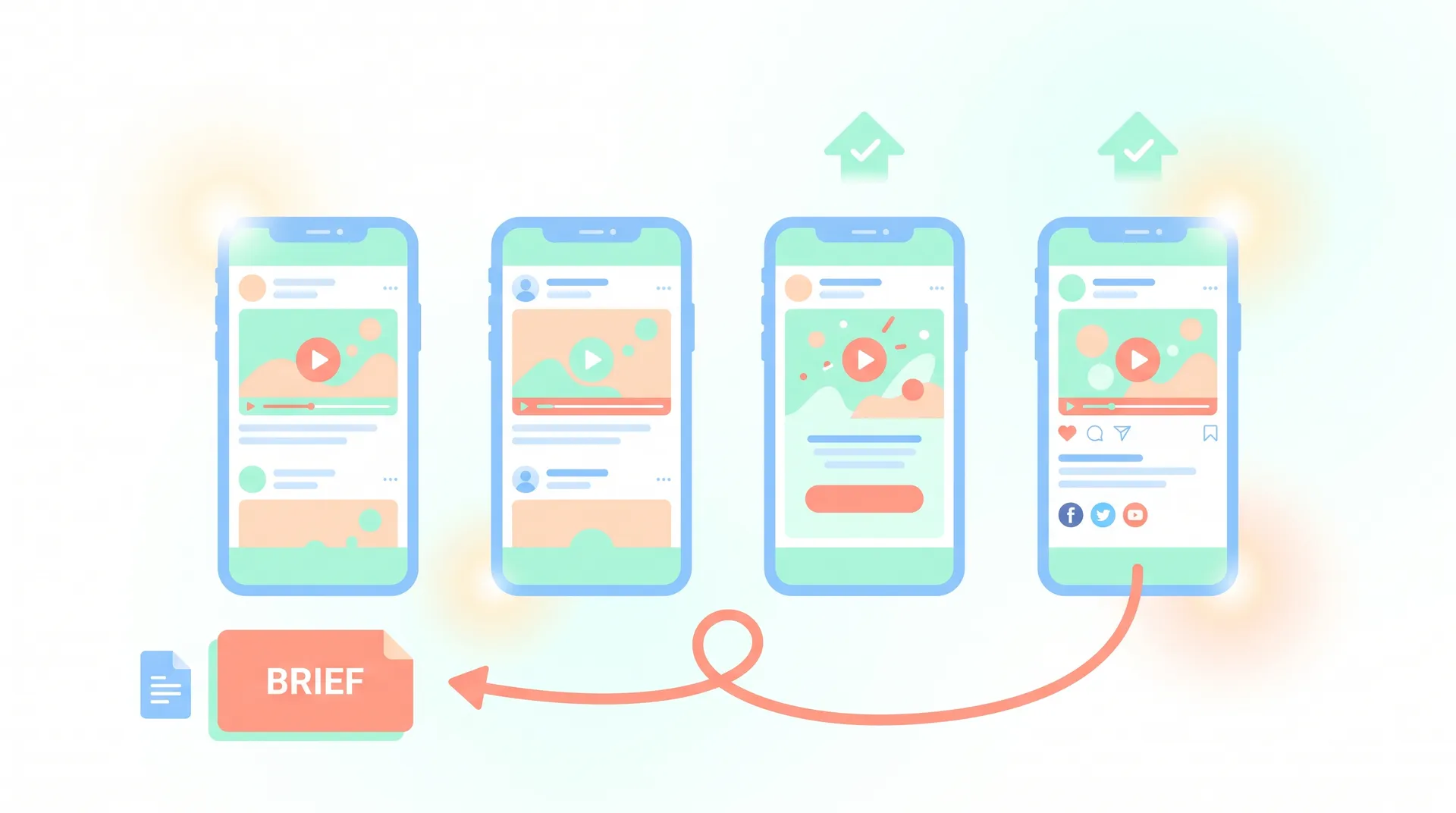
This is where I see even experienced media buyers waste the most money: they wait for statistical confidence instead of reading early spend signals.
The 48-hour read
You don't need a winner after two days. You need a loser list. Here's the shorthand I use with a $500-1,000 daily budget across a 10-variant batch:
- Killed within 48 hours: CTR under 0.7% with more than $30-40 spent, or CPA already 2x your target. These ads have told you everything they're going to tell you.
- On watch: average CTR, but hold rates look decent. Give them one more day before judgment.
- Spend magnets: the platform keeps feeding them budget and CPA is tracking toward target. These are your candidates.
Don't wait for Meta to declare a winner. The auction favors ads that get early engagement, and the algorithm itself will show you its preferences through spend distribution. An ad that the platform keeps spending on at 1.4x your target CPA is more interesting than a "safer" ad it refuses to deliver.
Watch the funnel, not just the top
High CTR with terrible conversion is not a hook problem — it's a promise problem. Your ad said something the landing page can't cash. That's still a useful result: it tells you the angle has stopping power, and the iteration needs to happen at the offer or landing level, not the creative.
I track three signals per variant in a simple spreadsheet: hook rate (3-second views ÷ impressions), hold rate (15-second views ÷ 3-second views), and CPA. When you separate those, you know which part of the ad broke. A great hook with a bad hold rate means your first 3 seconds work and the middle drags — and your TikTok UGC hook examples research pays off, while your script structure needs a rework.
Brief iterations without starting from scratch
Here's the part most brands skip entirely, and it's where all the leverage lives: the iteration brief.
When you find a winner, the temptation is to clone it blindly. Don't. The winner is a hypothesis about why it worked, and your iteration should test that hypothesis surgically.
The winner-decomposition step
Before briefing anything new, write down your theory: "Ad 7 won because of the confession-style hook plus the price objection at second 12." Now design iterations that isolate those elements:
- Keep the hook, change the body
- Keep the body, change the hook
- Keep the structure, change the creator
- Keep everything, change the opening shot
Each iteration is a one-variable experiment. This is where having real creative brief examples in your back pocket matters — an iteration brief isn't a fresh brief, it's a diff of the winner. "Same script, but open with the product mid-use instead of the talking head." That's a two-line brief. Creators love them because they've already internalized the winner's tone.
An iteration brief should be 80% "keep exactly what worked" and 20% "change this one thing." If your iteration brief looks like a brand-new brief, you're not iterating — you're rebooting.
Re-shoots are cheaper than you think
Because your iteration keeps the winning skeleton, a good creator can deliver 3-4 variants of a proven ad in under an hour of filming. We structure these as follow-up shoots with the same creator — the rapport is already built, they know the product, and honestly, the second shoot is always better than the first because they've seen which version won.
If you're working with creators on whitelisted ads, get the authorization setup right too — creator whitelisting for Meta ads lets you run iterations from their handle, which consistently outperforms brand-account delivery for UGC.
Scaling winners without killing them
The winner is confirmed. Now the mistake everyone makes: dumping 100% of budget onto one ad and strangling it.
Creative fatigue is mostly a frequency problem. One ad shown to the same audience six times a week burns out no matter how good it is. My scaling rule: when a variant holds target CPA for 5-7 days, duplicate it into a scaling campaign at 20-30% higher budgets, but keep 30-40% of total spend in the testing campaign. The day you stop testing is the day your pipeline of winners runs dry — and creative fatigue signals show up faster than most teams expect.
Watch frequency like a hawk. Past roughly 3.5-4 on Meta for a cold-audience ad, ROAS starts decaying predictably. Your iteration system is what fills the gap before that happens — a new variant of a proven winner typically extends its profitable life by 60-90 days.
And a note for creators reading this: if you can sell this system — not just film videos, but run the iteration logic — you're no longer a content vendor. You're a creative strategist, and you bill like one. We wrote a whole piece on positioning yourself as a UGC creative strategist for exactly this reason.
FAQ
Frequently Asked Questions
How many UGC ad variants should I launch at once?
How long should I run a UGC ad test before deciding?
How much should I spend per UGC ad variant during testing?
Should I test different creators or different concepts first?
How often should I iterate on a winning UGC ad?
What makes an iteration brief different from a regular creative brief?
Related reading
- UGC ads: the complete performance creative guide
- Creative brief examples for UGC hook A/B testing
- The UGC ad shoot brief: direct creators for paid social
- UGC ad creative fatigue: spot it and fix it fast
- How to write a UGC ad script that actually converts
- Meta ads library to launch: UGC campaign setup guide