How to position yourself as a UGC creative strategist
Learn how to specialize as a UGC creative strategist, what media buyers want in a portfolio, and how to pitch ad-specialist packages that command higher rates.

Most UGC creators are competing in the same pool — same rates, same one-size-fits-all packages, same portfolio of lifestyle clips that could belong to anyone. Then there's a smaller group who have repositioned themselves as creative strategists and are charging 3–5× more for essentially the same deliverables. The difference isn't the content. It's the framing.
This post is about how you make that shift.
What a creative strategist actually does (and why UGC creators are perfectly placed for it)
A creative strategist sits between the creative and the media buyer. They don't just film a video — they think about why a specific hook will outperform another, which angle speaks to a cold audience vs. a warm retargeting one, and how the ad's first three seconds drive thumb-stop rate. They speak the language of performance.
Here's the thing: most UGC creators already do this instinctively. You know what stops a scroll. You know that a hook showing a problem lands harder than one showing a product. You've just never packaged that knowledge as a sellable skill.
Media buyers — the people who actually spend six and seven-figure ad budgets on Meta and TikTok — are desperate for creators who understand performance, not just aesthetics. I've watched brands pay $50 per video to a creator who delivered pretty content, then turn around and pay $350 per video to a creator who delivered the same format but framed it in terms of CPA, hook rate, and creative fatigue windows. Same phone. Same ring light. Different positioning.
If you want the full context on what makes UGC work inside a paid media machine, read our UGC ads: the complete performance creative guide — it covers everything from brief-reading to delivery specs.
What media buyers actually look for in a UGC ad portfolio
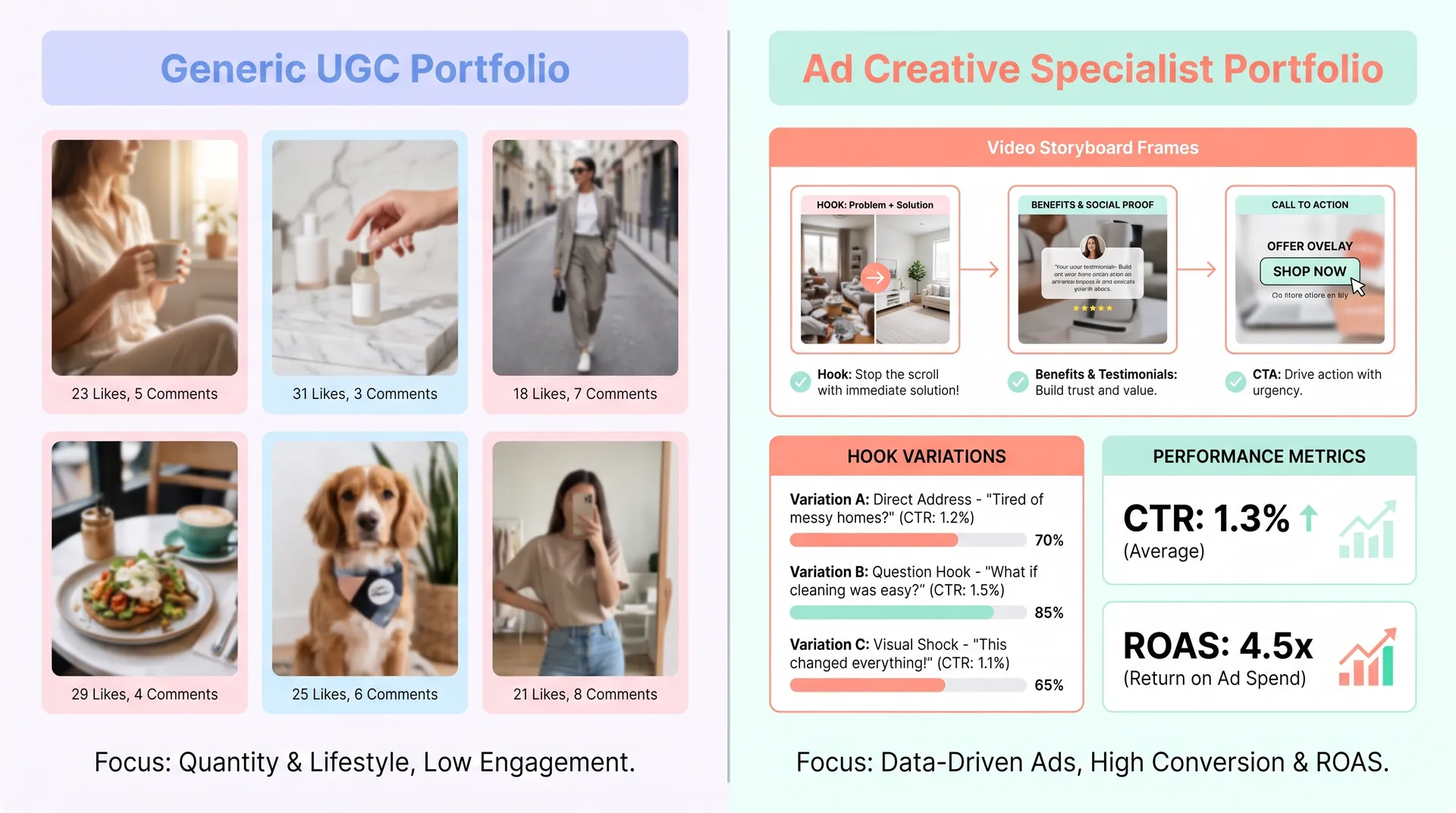
This is where most creators lose the deal before it even starts. A standard UGC portfolio shows finished videos. An ad creative specialist portfolio shows thinking.
Here's what a media buyer actually wants to see:
Hook variations. Not one version of an ad — three or four hooks for the same concept. Something like: hook A is a bold claim ("I stopped breakouts in 4 days"), hook B is a problem statement ("My skin was a mess until I found this"), hook C opens with social proof ("200,000 people use this every morning"). When you show hook variations, you're demonstrating that you understand creative testing — which is how media buyers actually operate.
Performance context. If you've had content run as an ad before, note it. Even rough numbers help. "This hook drove a 4.2% CTR on Meta" or "This video format outperformed the brand's control creative" is worth a thousand nice-looking thumbnails. Check out why UGC content beats polished ads on Meta and TikTok for the data to back up this positioning in conversations with buyers.
Format range. Show that you can do talking-head testimonials, B-roll product demos, problem-agitate-solve narratives, and social proof formats. A media buyer running a high-volume account needs creative variety to prevent ad creative fatigue. If your portfolio only shows one format, you look like a one-trick creator.
Brief adherence. Include a mock brief alongside one of your sample videos. Show exactly which brief element maps to which part of the creative. This single addition communicates more about your professionalism than anything else in your portfolio.
Quick audit: Pull up your current portfolio right now. Does it show hook variations? Does it reference performance metrics? Does it demonstrate you understand what a media buyer does all day? If the answer is no to all three, you're selling yourself as a commodity.
How to build the ad-specialist version of your portfolio from scratch
You don't need brand deals to build this. You need spec work — and you need to treat it like real ad briefs.
Start by picking three products you've actually used. For each one, write a performance creative brief using the structure a real media buyer would use: target audience, funnel stage (cold vs. warm), primary KPI, hook hypothesis, and CTA. Then film three to four hook variations for each product. You now have a portfolio that demonstrates strategic thinking, not just filming ability.
Understanding how to read a performance creative brief is the foundation here — if you're not fluent in brief language yet, start there before you build a single spec video.
One thing I'd encourage you to also include: a short written rationale (two to three sentences) for each creative choice you made. Why did you open with that hook? Why did you choose that CTA structure? Why did you cut at seven seconds instead of fifteen? This is what separates a creator from a creative strategist — the ability to articulate the why. Meta's own research consistently shows that the first three seconds determine whether an ad lives or dies in auction — demonstrate you know this.
Also worth adding to your portfolio: at least one example that shows understanding of creator whitelisting or dark post mechanics. These are intermediate-level concepts that signal you're not a beginner.
How to pitch ad-specialist packages (and what to charge)
Here's where you actually monetize the repositioning. Stop pitching "UGC videos" and start pitching "performance creative packages."
A performance creative package looks like this:
- Brief review and creative strategy session (30–45 minutes before filming) — you review the brief, ask questions about their current winning creative, and come back with a hook hypothesis
- 3–4 hook variations of the same core concept
- One long-form and one short-form cut of the winning hook (for testing across placements)
- Written creative rationale delivered alongside the videos
That's a package. And it's worth $400–$800+ per concept, not $75 per video.
When you pitch this, lead with outcomes, not deliverables. Instead of "I'll deliver 4 videos in 7 days," say "I'll deliver 4 hook variations designed for split-testing on Meta, with a written rationale so your media buyer can brief future iterations based on what wins." Those are two very different emails. TikTok's own creative best practice guides back up the split-testing approach — reference them in your pitch to show you've done the homework.
On the topic of pitching, pair this approach with A/B testing your hook concepts — brands who understand testing will immediately recognize the value of what you're offering.
Rate anchor: Position your package price against what a media buyer's hourly rate costs the brand. A good media buyer in the US bills at $150–$250/hr. If your creative package saves them two hours of brief-writing and creative direction, your $500 package is already paying for itself before a single impression is bought.
The language shift that makes the pitch land
This one is underrated. The words you use in your pitch email, your portfolio header, and your rate card all signal whether you belong in the performance creative world or the lifestyle content world.
Swap "content creator" → "performance creative specialist" Swap "I film videos" → "I develop and produce ad creative for paid social" Swap "hook ideas" → "hook hypothesis variants for A/B testing" Swap "I'll send you the video" → "I'll deliver ad-ready assets with usage rights for Meta/TikTok placements"
Check our guide on UGC videos: ad-ready vs. organic content explained — understanding that distinction deeply is what lets you use the language credibly, not just superficially.
None of this requires you to become a media buyer. You just need to understand how they think well enough to speak their language. According to Meta's Business Help Center, creative accounts for over 50% of ad performance variation — which means a media buyer's entire job depends on the quality of creative they're working with. Make that your pitch.
FAQ
Frequently Asked Questions
What does a creative strategist do in UGC?
Do I need a big following to become a creative strategist?
How much do UGC creative strategists charge?
What should a UGC ad creative portfolio include?
How is a creative strategist different from a UGC creator?
What do media buyers look for in a UGC creator?
Related reading
- UGC ads: the complete performance creative guide
- How to read a performance creative brief as a UGC creator
- How to write a UGC ad script that actually converts
- Creative brief examples for UGC hook A/B testing
- UGC ad creative fatigue: spot it and fix it fast
- Creator whitelisting for Meta ads: what you need to know
- How to Build a UGC Portfolio That Wins Campaigns