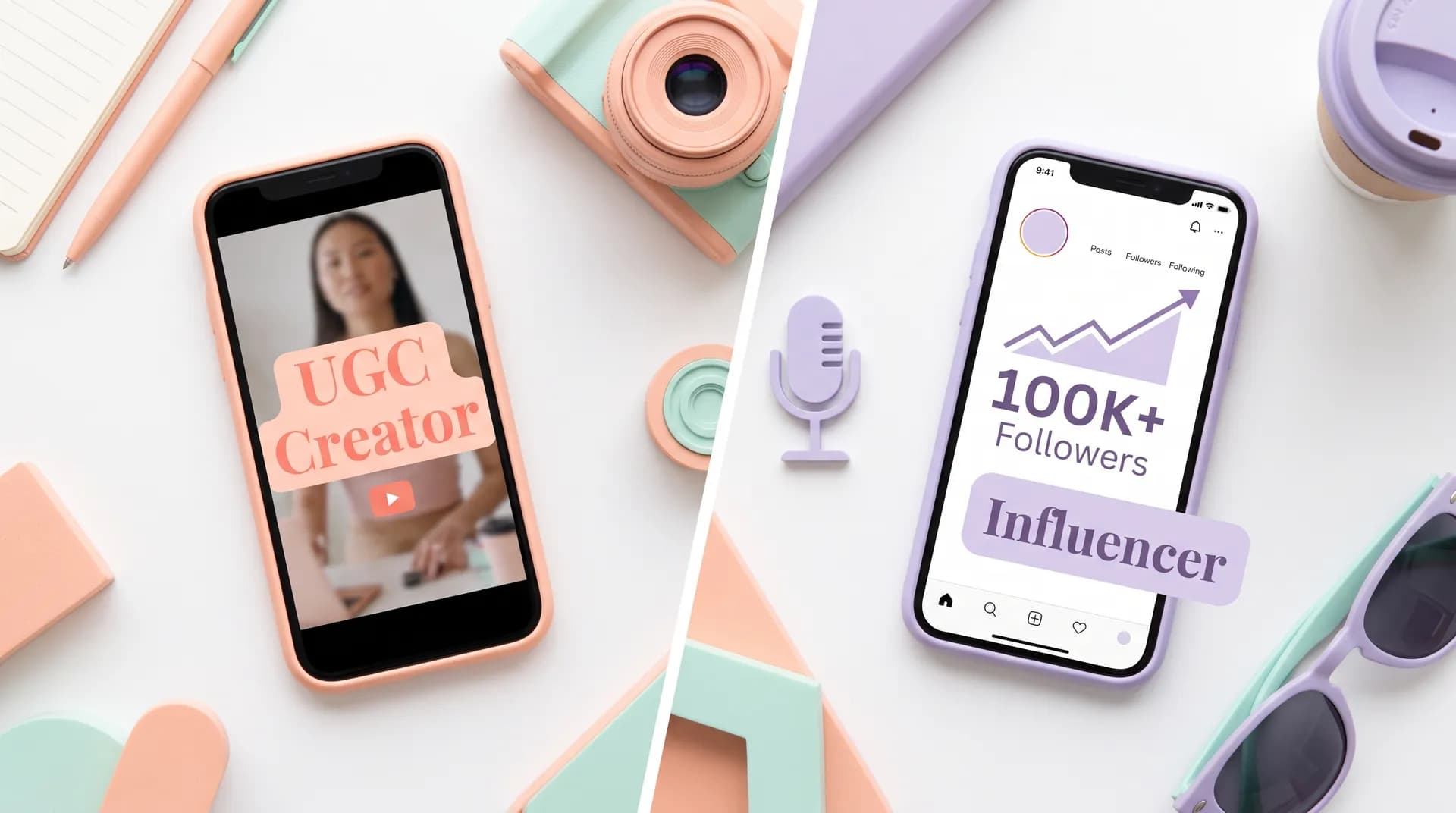
UGC creator vs. influencer: what's the real difference?
No followers? No problem. Learn the real difference between a UGC creator and an influencer — and which path actually fits you in 2025.

Most people stumble into the UGC creator vs. influencer question because they assume these are just two words for the same thing. They're not — and mixing them up is costing beginners real money.
I've watched creators pitch themselves as "influencers" to brands, get ghosted, then pivot to UGC and land their first paid deal within two weeks. The difference isn't semantic. It changes how you're hired, what you deliver, what you get paid, and whether you even need an audience at all.
Here's exactly how these two roles split.
The core UGC creator vs. influencer divide
The simplest version: an influencer gets paid to post. A UGC creator gets paid to make content the brand posts.
That's the whole thing. But the downstream effects of that distinction are enormous.
When a brand hires an influencer, they're buying access to that creator's audience. Your followers, your reach, your engagement rate — that's the product. The content is just the vehicle. A brand with 50,000 followers on Instagram doesn't care how good your video looks if it's going to their page. They're paying for your 200,000 followers to see it.
When a brand hires a UGC creator, they're buying the raw asset. The video itself. They'll run it as a paid ad, drop it on their own channels, use it for product pages, A/B test five variations of it against each other. Your follower count is completely irrelevant to them because your audience never enters the picture.
That single difference ripples through everything else.
Follower count: matters vs. doesn't
Influencer rates are almost entirely driven by audience size. No followers, no deal — or at best, a low-ball gifting offer with no cash.
UGC creators don't have that problem. I've seen creators with zero Instagram followers charge $250 per video and get paid. I've seen people pull in $3,000–$5,000 a month doing UGC while their TikTok sits at 800 followers. The portfolio matters. The follower count doesn't.
This is why UGC is the path I always recommend for people starting from scratch. You don't have to spend 18 months building an audience before you see your first dollar. You just have to learn how to make content that converts — and that's a learnable skill.
Who owns the content
With influencer posts, you own the content you create. The brand licenses it for a set period, or they ask for repurposing rights (which should cost extra — see UGC whitelisting rights: what they are & what to charge).
With UGC, the brand typically owns the final deliverable outright. That's baked into the deal. You're being paid as a content producer, not a publisher. The brief comes from them, the creative direction comes from them, and when you hand over the files, they own them. This is standard. Don't fight it on UGC deals — just make sure your rate reflects it.
The deliverables
Influencer deliverables are distribution-focused: "one in-feed post + three Stories" or "one 60-second TikTok, posted by Friday."
UGC deliverables are production-focused: "three raw video files, no caption, no branding overlay, exported in 1080p, delivered via Google Drive." No posting required. Sometimes brands want multiple versions of the same concept — different hooks, different CTAs — specifically for ad testing.
This changes how you scope and price your work entirely.

What this means if you're choosing a path
If you have an engaged audience already and brands in your niche are actively running influencer campaigns, the influencer route makes sense. Your existing platform is worth money.
But if you're starting out, or you've been grinding for months and your audience just won't grow — UGC is a completely parallel track that doesn't require any of that. You can be a full-time UGC creator and never post a single piece of content under your own name. Plenty of people do exactly that.
The other thing worth saying: these paths aren't mutually exclusive. A lot of people start with UGC, build confidence and cash flow, then slowly grow an audience and layer in influencer deals on top. That's actually a smart sequence. UGC pays while you build. Check out how to become a UGC creator: the complete guide if you want the full roadmap on getting started from zero.
The payment structures are different too
Influencers typically get paid a flat fee per post, sometimes with a performance bonus or affiliate component. Rates are often negotiated around CPM (cost per thousand impressions) — if your account gets 100,000 impressions per post and the brand pays $20 CPM, that's a $2,000 post.
UGC creators get paid per deliverable. $150–$400 per video is a typical beginner range. More experienced creators charge $500–$800 per video, and that scales with usage rights, exclusivity, and how many concepts are included. There's no audience metric involved — just the asset and what the brand plans to do with it.
Creative control flips completely
Influencers usually have more creative latitude. Brands hire them specifically because their voice, aesthetic, and audience trust is already established. Dictating too much creative direction would undermine that authenticity.
UGC creators often work from a detailed brief. Brands send you talking points, script outlines, shot lists, even reference videos. You execute the vision. It's less about your personal brand and more about matching the brand's performance creative style. Some people love this — no pressure to maintain a "personal brand," no algorithm to feed. Others find it creatively limiting. Know which camp you're in before you start.
If you want to sharpen the craft side of executing a brand brief, understanding a framework like Problem-Agitate-Solve is genuinely useful — it's how most high-converting UGC scripts are structured, and brands expect you to know it.
The UGC creator meaning in practice
The term "UGC creator" has evolved. It originally described organic content that real customers posted voluntarily — think someone filming themselves unboxing a product they bought. Brands noticed that kind of content outperformed their polished ads, and the paid UGC industry grew out of that insight.
Today, a UGC creator is essentially a freelance content producer who makes ad-ready assets that look like organic content. The "user-generated" label is almost nostalgic at this point — there's nothing accidental about it. It's a professional service with deliverables, contracts, and rates.
According to Influencer Marketing Hub, 79% of people say UGC highly impacts their purchasing decisions, which is precisely why brands keep funding it. And because it performs better than polished studio ads on platforms like Meta and TikTok, demand for UGC creators has only grown.
The influencer model isn't going anywhere either. Linqia's State of Influencer Marketing report consistently shows brand budgets flowing toward creator partnerships — but increasingly those are performance-oriented deals that look a lot more like UGC than traditional endorsements.
The line between the two is blurring. But for someone deciding where to focus their energy right now, the distinction still matters a lot.
Quick comparison
| UGC Creator | Influencer | |
|---|---|---|
| Needs followers | No | Yes |
| Content posted by | Brand | Creator |
| Owns the content | Brand | Creator |
| Paid based on | Deliverables | Audience size |
| Creative direction | Brand-led | Creator-led |
| Barrier to entry | Low | High (requires audience) |
If you're earlier in your creator journey — no real audience, no viral moments, but you can hold a camera and talk convincingly about a product — UGC is the faster path to actual income. That's not a consolation prize. The most successful UGC creators I know went full-time without ever becoming "influencers" in the traditional sense.
Pick the path that matches where you are right now.
Frequently Asked Questions
What is the main difference between a UGC creator and an influencer?
Do UGC creators need followers to make money?
Who owns the content in a UGC deal?
Can you be both a UGC creator and an influencer?
How much do UGC creators charge vs. influencers?
Is UGC easier to get started with than influencer marketing?
Related reading
- What is a UGC creator? (And what it means in 2025)
- How to become a UGC creator: the complete guide
- What is UGC? The plain-English definition brands use
- How to film UGC content that converts (full guide)
- UGC whitelisting rights: what they are & what to charge
- UGC creator side hustle to full-time: when to leap