UGC video ideas: 12 high-converting formats with examples
12 proven UGC video ideas broken down by format, with real examples and guidance on which product categories each one suits best.

A supplement brand I was talking to last year had 47 UGC videos sitting on their hard drive. Not a single one was running as an ad. Know why? Every creator had sent them a vague talking-head monologue. Same format, same delivery, same forgettable result. The problem wasn't the creators — it was that nobody had told them which UGC video ideas actually move product for a supplement brand specifically.
Format is strategy. Picking the wrong one for your product category is like writing a perfect script and then whispering it.
This post breaks down 12 formats I see converting right now, with one real-world example per format and a clear read on which product categories each one actually suits. Before you film anything, though, you'll want to nail the fundamentals in How to film UGC content that converts (full guide) — this post builds on top of that foundation.
The 12 UGC video ideas that consistently convert
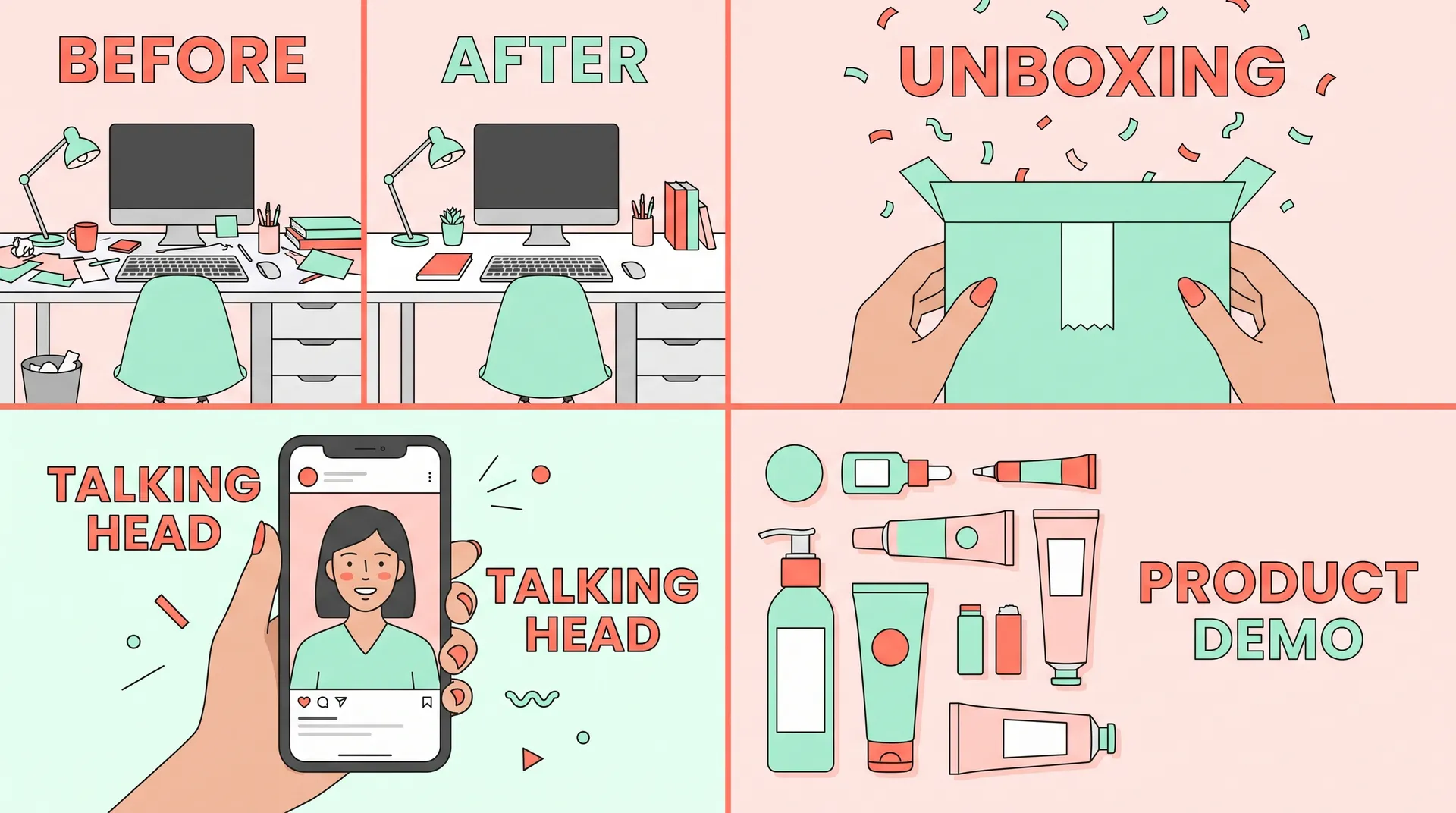
1. Unboxing
What it is: Camera rolls as the creator opens packaging for the first time. No cuts before the reveal. Genuine reactions only.
Real-world example: A creator receives a new pair of wireless earbuds. She films her hands peeling the box open, reacts to the magnetic lid, holds the case up to show the matte finish, and tests one earbud in her ear before the video ends. No scripted lines. Thirty seconds.
Best for: E-commerce products with premium or distinctive packaging — beauty, tech accessories, subscription boxes, apparel. The format tanks for service-based brands or anything where the physical product is boring to look at.
Why it converts: Curiosity is the hook. The viewer wants to see what's inside almost as much as the creator does. This format also implicitly signals authenticity — it's hard to fake a first reaction.
2. Testimonial (talking head)
What it is: Creator speaks directly to camera about their experience with a product. No B-roll, no demonstrations. Just them and their words.
Real-world example: A skincare creator sits near a window with clean natural light, looks into the lens, and says: "I've tried seven different vitamin C serums this year. This is the only one that didn't make my skin peel after week one. I'm on my third bottle." That's it. Twenty-two seconds.
Best for: Supplements, skincare, fitness programs, apps, and anything where personal results are the main selling point. If your brand's promise lives in the outcome, not the product itself, the testimonial format is your workhorse.
Check out Talking head UGC: on-camera delivery tips that build trust before you film one of these — delivery kills more testimonials than bad scripts do.
3. Tutorial / How-to
What it is: Creator shows the viewer how to use the product, step by step. Usually 30–60 seconds on short-form platforms.
Real-world example: A creator films herself applying a hair styling cream. She shows wet hair, section by section application, the diffuser attachment, and the final result — all in under 45 seconds. The product name appears naturally when she picks up the tube.
Best for: Anything with a learning curve or multiple use cases — makeup, cooking tools, software, cleaning products, baby gear, fitness equipment. If a customer could use the product "wrong," a tutorial converts well because it removes friction before purchase.
4. Before / After
What it is: Two states separated by the product. Can be side-by-side, a swipe reveal, or sequential clips. No fluff in between.
Real-world example: A teeth-whitening brand creator shows a close-up of teeth on day one, then day fourteen. That's the whole video. The copy on the clip reads: "14 days, no dentist." Hooks, proof, done.
Best for: Beauty, skincare, teeth whitening, home cleaning, weight management, organization products, and any fitness category where visual transformation is the point. The format struggles for products where results are invisible or felt internally (think: supplements for energy or sleep).
The before/after format is the most frequently rejected by Meta's ad reviewers when it implies medical claims. Keep the visual honest and avoid phrases like "treat," "cure," or any before that looks like a medical "condition." Stick to cosmetic or lifestyle transformations.
5. Day-in-the-life (DITL)
What it is: Creator weaves the product into their actual daily routine. Not a demo, not a review — just the product living in a real life.
Real-world example: A creator's morning routine video shows her making coffee, taking her AG1 greens in a shaker, doing a 20-minute workout, and showering. The supplement appears for maybe eight seconds of total screen time. It sold harder than any explicit demo they'd run.
Best for: Wellness, supplements, coffee and food products, fitness apps, clothing and accessories, skincare routines. Products that want to be associated with an aspirational lifestyle rather than a single moment of use.
6. Product comparison
What it is: Creator puts two or more products head-to-head. Can be "old vs. new," "cheap vs. premium," or "theirs vs. competitor's."
Real-world example: A creator lines up three protein powders, mixes each one in identical amounts of water, and rates them on taste, texture, and clumping. The brand's product wins on mixability. No scripted winner announcement — just the creator's honest reaction to each sip.
Best for: Supplements, food and drink, cleaning products, beauty tools, tech accessories. Comparison videos work especially well in crowded categories where differentiation matters. Most brands won't request a direct competitor comparison, but "old solution vs. this product" always flies.
7. UGC unboxing haul
What it is: Multiple products from the same brand or category, opened and shown together. Higher volume, faster pace than a single unboxing.
Real-world example: A creator opens a box of eight different items from a sustainable home goods brand — beeswax wraps, bamboo utensils, reusable bags. She holds each item up briefly, gives a one-sentence take, and moves on. The whole thing runs 60 seconds.
Best for: Subscription boxes, multi-product brands, beauty brands with large SKU catalogs, gift brands. Works best when the variety itself is a selling point. Skip it if the brand only has one or two products — it'll feel padded.
8. POV (point of view)
What it is: The camera represents the viewer's eyes. Creator speaks to the lens as if they're talking directly to the viewer's situation. Often starts with "POV: you finally try…"
Real-world example: "POV: you've had tension headaches for three weeks and your friend sends you this." Camera shows a magnesium supplement. Creator pours one out, takes it, fast-forwards with a text overlay: "Day 4. Still skeptical." Then: "Day 11. I bought three more." Fifty seconds.
Best for: Problem-solution products in health, wellness, and productivity. Also converts well for apps, gadgets, and anything where the viewer has a specific pain point the product addresses. The format has a built-in hook — the viewer self-selects because they recognize their own problem.
Getting the hook right in the first three seconds is everything in POV videos. Read UGC video hooks: stop the scroll in 3 seconds and structure your open around it.
9. Myth-busting / Objection-crusher
What it is: Creator addresses the #1 reason people don't buy and dismantles it. Sometimes framed as "I was wrong about X."
Real-world example: "I thought I couldn't take collagen supplements because I'm vegan. Turns out this brand's formula is 100% plant-based. I've been taking it for six weeks." The rest of the video shows the product label. Handles the objection, presents proof, done.
Best for: Products with a known stigma or misconception — supplements, fitness programs, unconventional skincare ingredients, budget alternatives to premium brands. Any category where "I thought it wouldn't work for me" is a common purchase blocker.
10. Skit / Relatable scenario
What it is: Short comedic or relatable scene that dramatizes the problem the product solves. Less talking-head, more mini-narrative.
Real-world example: A creator films herself "looking" for a charging cable while her phone dies at 1%. She gives up, slumps back — then a MagSafe charging pad is shown sitting two feet away, untouched. Text overlay: "I bought this six weeks ago and still can't believe I waited so long." Nine seconds of skit, six seconds of product truth.
Best for: Tech accessories, organizational products, household tools, apps, anything that solves a first-world frustration people actually laugh about. This format works best when the pain point is universally recognizable. It flops when the scenario feels forced or the punchline needs explaining.
11. Unboxing + first impression combo
What it is: Hybrid of the unboxing and testimonial. Creator opens the product live, uses it immediately, and gives a first reaction within the same video.
Real-world example: A beauty creator opens a new foundation stick on camera, swatches it on her arm, applies a section to her face, blends, and gives her reaction before the video ends: "Wait — it doesn't crease at my nose? I'm actually shocked." All in 55 seconds.
Best for: Makeup, skincare, food, and any product where the experience of trying it for the first time is satisfying to watch. The format combines the curiosity hook of an unboxing with the social proof of a live reaction. It's harder to fake, which makes it feel more trustworthy to viewers.
12. Results-driven social proof mashup
What it is: Creator compiles multiple uses, multiple days, or multiple community results into a fast-paced clip. Often uses text overlays to convey data or feedback.
Real-world example: A fitness app creator films six 3-second clips across three weeks — week one workout, week one feels, week two harder session, week two results, week three progress, week three final read. Text overlays show stats. Ends with "Week 3. Down 4.2 lbs. Still going."
Best for: Fitness, wellness, habit-building apps, supplements, and any product where results accumulate over time. Great for brands that have strong retention data or user milestones to show.
Which format matches which product category
I get asked this constantly, so here's my honest quick-reference:
| Product Category | Top 3 Formats |
|---|---|
| Skincare / Beauty | Before/After, Tutorial, Unboxing + First Impression |
| Supplements | Testimonial, POV, Day-in-the-Life |
| Tech Accessories | Unboxing, Skit, Tutorial |
| Fitness / Apps | Results Mashup, Day-in-the-Life, Testimonial |
| Food & Drink | Tutorial, Comparison, Day-in-the-Life |
| Subscription Boxes | Haul Unboxing, Unboxing, Results Mashup |
| Home & Cleaning | Before/After, Tutorial, Skit |
One format I'd steer most brands away from by default: the rambling talking-head monologue that covers every feature in one video. Brands love requesting them. They perform worse than almost everything else I've listed here. Specificity beats comprehensiveness every time on short-form video.
If a brand brief doesn't specify a format, ask. The format is at least as important as the script — and a good brief will already have it figured out. If you're writing your own concept, choose the format before you write a single line of dialogue.
Getting the script right for each format
Format determines structure, but the UGC scripting: the Problem-Agitate-Solve framework is what fills each format with words that convert. PAS works differently depending on the format — in a testimonial, the "problem" is your personal backstory; in a skit, it's the dramatized scenario. It's worth reading through how to apply it before you write.
If you're newer to production and want practical filming guidance that covers angles, framing, and lighting alongside format selection, How to film UGC content with just your phone is a solid companion piece.
Research from Nielsen consistently shows that 88% of consumers trust peer recommendations more than brand content — which is the fundamental reason these formats outperform polished brand ads. Stackla's consumer content report found that 79% of people say UGC highly impacts their purchasing decisions. And Meta's own creative guidance confirms that authentic, lo-fi creative consistently outperforms high-production ads in direct response campaigns. Format is how you deliver that authenticity in a way that also has a point.
Pick your format deliberately. Film with intention. Then UGC video pacing: edit for watch time and conversions for the final step that ties it all together.
Frequently Asked Questions
What are the best UGC video ideas for beginners?
How long should a UGC video be?
Which UGC format performs best for Meta ads?
Can I use the same UGC video format for every brand I work with?
What's the difference between a UGC testimonial and a talking head video?
How many UGC video formats should I include in my portfolio?
Related reading
- How to film UGC content that converts (full guide)
- UGC video hooks: stop the scroll in 3 seconds
- Talking head UGC: on-camera delivery tips that build trust
- UGC scripting: the Problem-Agitate-Solve framework
- UGC video pacing: edit for watch time and conversions
- UGC video formats brands actually buy (with examples)
- How to film UGC content with just your phone