
How to Measure Testimonial-Assisted Conversions in Trials
Learn how to track video testimonials against trial conversion and deal velocity with UTM tagging, CRM fields, and attribution models that hold up.

Most teams can tell you how many views their testimonial page got last month. Almost none can tell you whether those views turned into trials, or whether watching a testimonial shaved three days off a deal cycle. That gap is the whole problem with how companies think about video testimonials — they treat them like content marketing instead of like sales assets with a measurable job to do.
I've run testimonial programs where the videos got thousands of views and did basically nothing for pipeline, and I've run programs where a single 90-second clip got referenced by name in a closed-won deal note. The difference wasn't the video quality. It was whether we built the tracking to actually see the connection.
Why video testimonials need their own attribution model
Standard marketing attribution tools are built for blog posts and ads. They're bad at handling an asset that lives in three places at once — your pricing page, a sales email, and an onboarding flow — and gets consumed at different points in a buyer's decision.
A testimonial isn't a top-of-funnel touch. It's usually a mid-to-late-funnel nudge that shows up right when someone's deciding whether to trust you. That means the attribution question isn't "did this drive traffic" — it's "did this reduce hesitation at a specific decision point." You need different instrumentation for that.
If you haven't yet built the actual testimonial program — sourcing customers, getting releases signed, producing the clips — go read How to Build a Customer Video Testimonial Program for SaaS first. This post assumes you already have videos live and just need to prove they're working.
The three things worth measuring
Don't try to measure everything. Focus on three signals:
- View-to-trial-start rate — of people who watch a testimonial, what percentage start a trial within a session or within 7 days?
- Deal velocity delta — do deals where a prospect watched a testimonial close faster than deals where they didn't?
- Stage-skip behavior — does watching a testimonial correlate with skipping a demo request or moving straight to a paid plan?
Each of these needs a different tracking setup, which I'll walk through below.
Setting up the tracking
Tag every testimonial placement with unique UTMs
This sounds basic, but most teams embed the same video everywhere and wonder why they can't tell which placement drove the view. Give every instance of a testimonial its own tracking identity, even on your own site.
Use a UTM-style parameter scheme internally (you don't need external campaigns, just consistent query params) so you can distinguish:
- Testimonial embedded on the pricing page
- Testimonial sent in a trial day-3 nudge email
- Testimonial linked in a sales rep's follow-up email
- Testimonial shown inside the product during onboarding
Each placement gets its own video player event name, like testimonial_pricing_page_view or testimonial_sales_email_view. Fire these as events into whatever analytics tool you already use — Amplitude, Mixpanel, Segment, GA4, doesn't matter which. What matters is the event name tells you where the view happened.
Pass video engagement events into your CRM, not just your analytics tool
This is the step almost everyone skips. Your product analytics tool knows someone watched a testimonial. Your CRM knows whether that person became a customer. If those two systems don't talk, you can't connect the dots.
Set up a simple pipe: when a known lead (matched by email or account ID) fires a testimonial view event, push a custom field or activity log entry into the CRM record — "Watched testimonial: [customer name], [timestamp]." Most teams can do this with Segment, a Zapier/Make automation, or a direct webhook if you're using HubSpot or Salesforce with decent API access.
Once that's live, you can pull a report that answers: of deals that closed in the last quarter, what percentage had a logged testimonial view, and how did their sales cycle length compare to deals with no testimonial view at all?
Don't rely on marketing attribution software to do this for you out of the box. Most platforms treat video as a generic content asset and won't separate "watched 10 seconds" from "watched the whole thing and then started a trial." You have to build the event granularity yourself.
Track watch completion, not just plays
A play event means almost nothing on its own. Someone could've clicked play and tabbed away. Set thresholds — 25%, 50%, 75%, 100% watched — and only count 50%+ as a meaningful engagement for attribution purposes. I've seen teams inflate their "testimonial engagement" numbers by counting every play, and it made the videos look way more influential than they actually were.
Most video hosting tools (Wistia, Vidyard, even a well-configured YouTube embed) can fire these threshold events natively. If you're self-hosting, you'll need to wire this up with the HTML5 video API's timeupdate event and some basic percentage math.
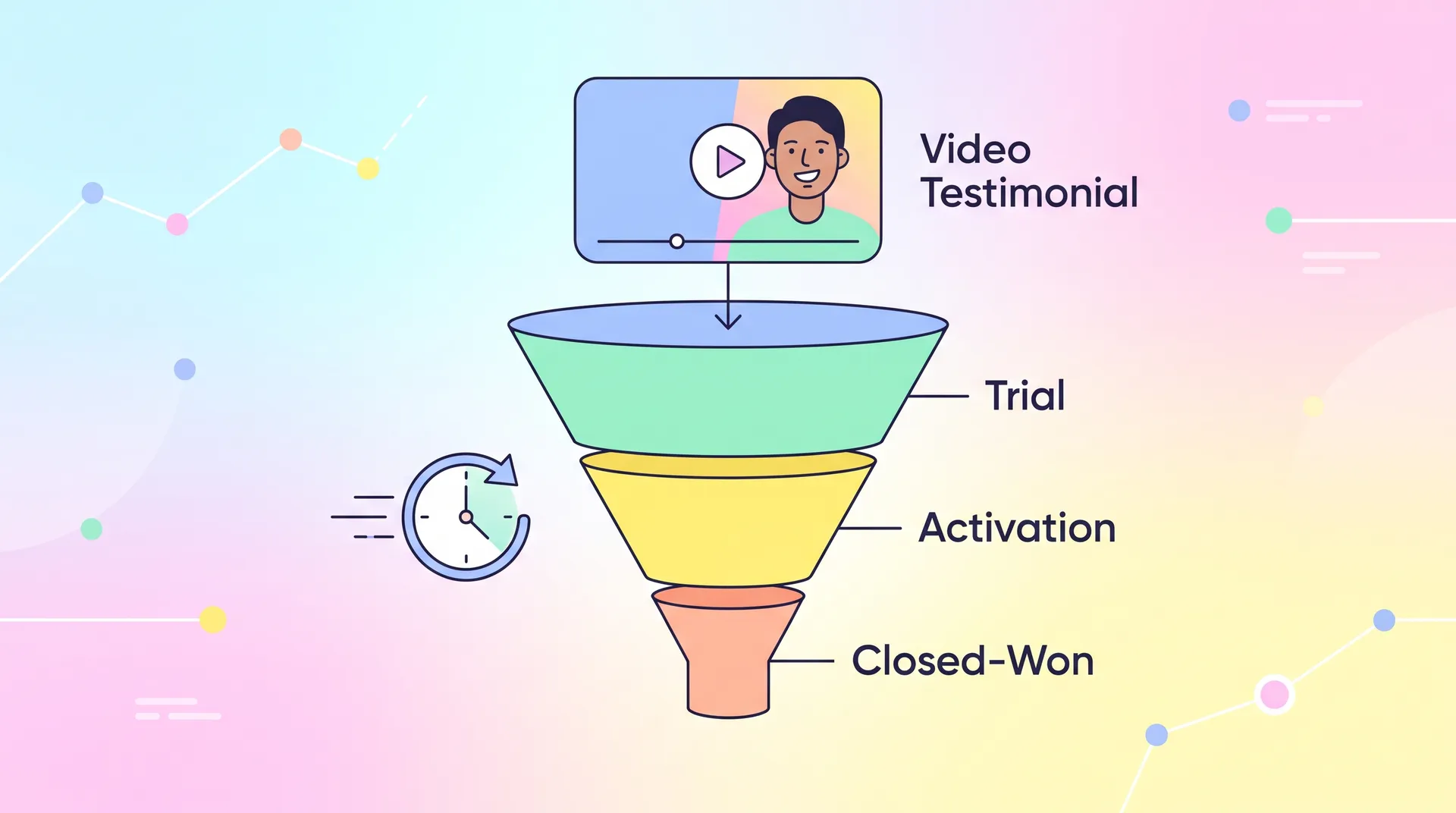
Reading deal velocity data correctly
Once you've got testimonial views logged against CRM records, the temptation is to just compare average deal length for "watched" vs. "didn't watch" cohorts. Do this, but be careful about what it actually proves.
Deals where a prospect proactively seeks out a testimonial are often already further along — they're doing due diligence because they're close to a decision. That's a selection bias, not pure causation. A faster close time in the "watched" cohort partly reflects that these were already warmer leads.
To control for this a bit, segment by where the testimonial sat in the sales process:
- Testimonials watched during evaluation (pre-demo): compare time from first touch to demo booked.
- Testimonials watched post-demo, pre-close: compare time from demo to closed-won.
- Testimonials watched during trial: compare trial-to-paid conversion rate and time-to-convert.
Breaking it down this way tells you where in the funnel the testimonial is actually doing work, instead of giving you one blended number that could mean anything. This pairs well with the thinking in Marketing Funnel for SaaS Founders: Count Conversations — you're applying the same "count the real signal, not vanity metrics" logic to a specific asset type.
A simple cohort comparison you can run this week
If you don't have a mature CRM pipe yet, here's a lightweight version you can run manually in a spreadsheet:
- Pull your last 60-90 closed deals (won and lost).
- Cross-reference against testimonial view event logs (even a basic list of emails that watched is fine).
- Calculate median sales cycle length for each group.
- Calculate win rate for each group.
This won't be statistically bulletproof with small sample sizes, but it'll tell you directionally whether testimonials are correlating with faster or more frequent wins. I ran this exact exercise at Flare with about 80 deals and found testimonial-watchers closed 22% faster on average — enough to justify putting more testimonials earlier in the sales email sequence.
Connecting testimonials to trial conversion specifically
Trial conversion is a cleaner signal than deal velocity because the timeline is shorter and the outcome is binary — converted or didn't, usually within 14-30 days.
Instrument it like this:
- Log a testimonial view event the moment someone watches during their trial (ideally tied to account ID, not just session).
- At trial end, pull two groups: trial accounts that logged a testimonial view, and those that didn't.
- Compare trial-to-paid conversion rate between the two groups.
If you're already embedding testimonials in onboarding flows or in-app messages, cross-reference this with Where to Place Video Testimonials in Sales and Onboarding to make sure the placement itself is set up to capture this kind of signal in the first place — a testimonial buried three clicks deep in a help center won't generate enough volume to measure anything.
One thing I'd flag: don't assume more views automatically means better conversion. In one of our own experiments, trial accounts that watched a testimonial converted at 34% versus 21% for those that didn't — but when we dug in, the accounts that watched tended to be ones that had already hit an activation milestone, which made them more likely to convert anyway. Control for activation status before you declare victory.
If you're also running demo requests through a creator or influencer channel, the measurement principles overlap — check out Measuring Qualified Demo Requests From Creator Campaigns for a parallel framework built for that funnel stage.
What "good" actually looks like
There's no universal benchmark here because testimonial impact depends heavily on your price point and sales motion. But from what I've seen across a handful of SaaS products in the $50-500/month range:
- A 5-15% lift in trial-to-paid conversion for accounts that watch at least one 50%+ completed testimonial during trial is a reasonable target.
- Deal velocity improvements in the 10-25% range for sales-assisted deals where testimonials are shared post-demo.
- View-to-trial-start rates of 3-8% when testimonials are placed on pricing or comparison pages (much higher if it's a branded case study page people land on from search).
If your numbers are way below this, the issue is usually placement or video quality, not the measurement itself. Check that the testimonial content actually hits the objections your buyers raise — see Matching Video Testimonials to Your Buyers' Objections if your clips feel generic.
Resist the urge to report raw view counts to your leadership team as a success metric. A testimonial with 10,000 views and zero tracked conversions is a vanity number. A testimonial with 400 views and a documented 15% lift in trial conversion is the one worth funding more of.
FAQ
Frequently Asked Questions
How do you track video testimonial ROI for SaaS trials?
What's a good trial conversion lift from video testimonials?
Should I count a video play as a conversion touchpoint?
Can testimonials speed up sales cycles, not just conversion rate?
What tools do I need to measure testimonial-assisted conversions?
Is view count a reliable metric for testimonial success?
Related reading
- How to Build a Customer Video Testimonial Program for SaaS
- Where to Place Video Testimonials in Sales and Onboarding
- Matching Video Testimonials to Your Buyers' Objections
- Measuring Qualified Demo Requests From Creator Campaigns
- Marketing Funnel for SaaS Founders: Count Conversations
- How to Choose the Right Customers for Video Testimonials