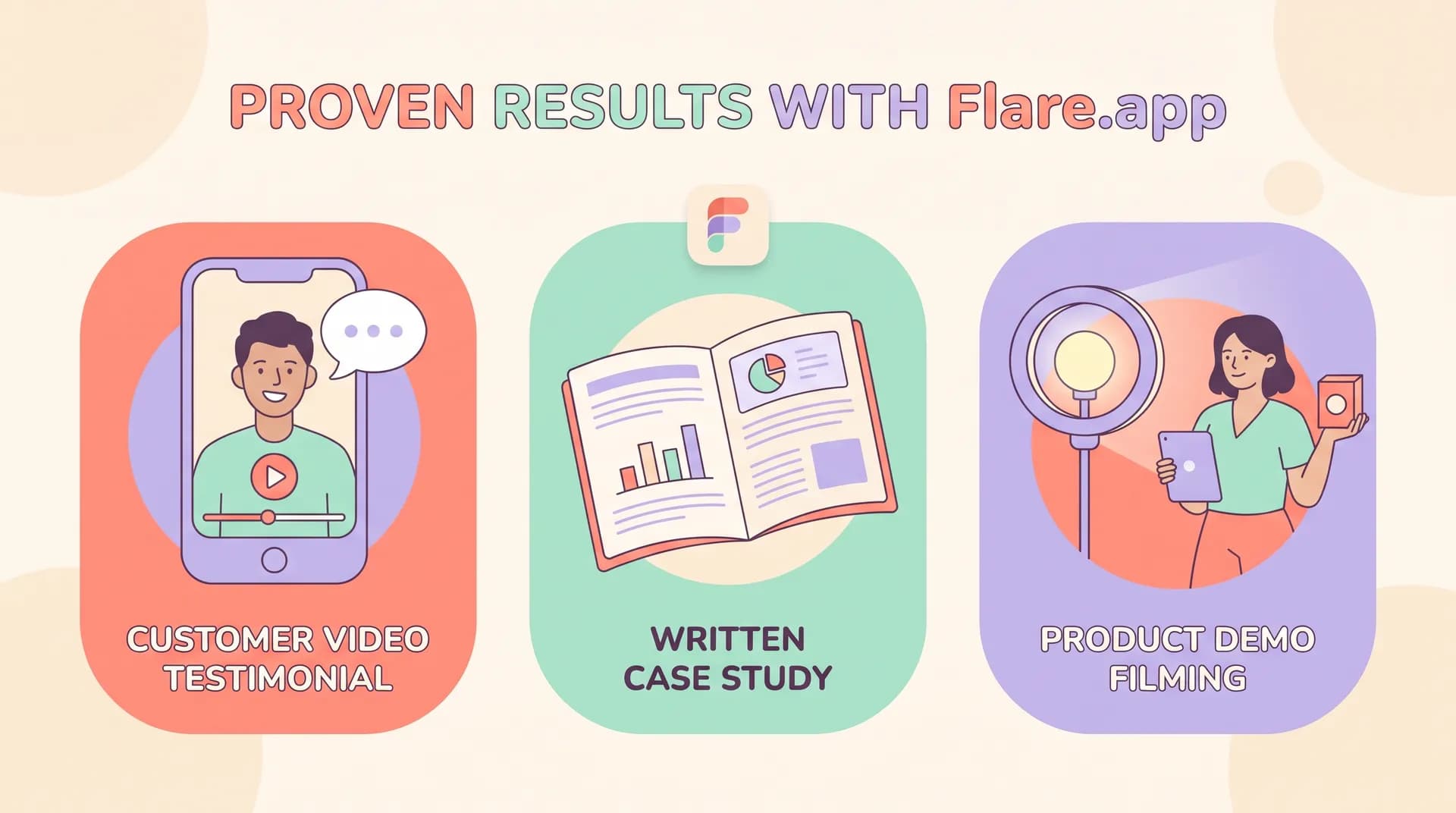
Testimonial vs Case Study vs Creator Demo: Pick Right
Confused which proof asset to commission? Video testimonial examples, written case studies, and paid creator demos each solve a different problem.

I once watched a marketing team spend six weeks and $4,000 producing a slick paid creator demo for a feature that needed a $0 customer testimonial instead. The demo looked great. It converted worse than the shaky iPhone video a customer sent us for free three months later. That's the moment I realized most teams don't have a video testimonial examples problem — they have a "which proof format even fits here" problem.
I've run Flare for years watching SaaS and app teams commission all three of these: real customer testimonials, written case studies, and paid creator demos. They get blurred together constantly, treated like interchangeable flavors of "social proof content." They're not. Each one answers a different question your buyer is asking, and using the wrong one in the wrong spot wastes money and, worse, erodes trust.
Video testimonial examples: what they're actually for
A real customer video testimonial exists to answer one question: "Can I trust that this actually worked for someone like me?" That's it. It's not there to explain your feature set or walk through a workflow. It's there to let a skeptical prospect see a real human, with a real face and a real voice, say "yeah, this was worth it."
The best video testimonial examples I've seen share a few traits. They're short — 60 to 90 seconds. They're specific — "we cut onboarding time from 12 days to 3" beats "it's been great for our team." And they're visibly unscripted, even if there was a loose structure behind the scenes. Prospects have gotten very good at smelling a script.
Where testimonials shine:
- Bottom-of-funnel landing pages, right near the CTA
- Pricing pages, next to the plan that objection applies to
- Sales decks, cued up to the specific minute a rep needs
- Retargeting ads to warm audiences who already know your category
Where they fall flat: top-of-funnel awareness, explaining a complex workflow, or demonstrating a brand-new feature nobody's used yet. A testimonial from someone who hasn't tried your new AI feature is just an opinion, not proof.
If you're building a real pipeline for these — finding the right customers, asking at the right moment, editing without wrecking the authenticity — our pillar guide on how to build a customer video testimonial program for SaaS walks through the whole system. This post is about picking the right format before you get there.
The trust math behind testimonials
Nielsen's trust research has shown for over a decade that people trust recommendations from people they perceive as "like them" far more than branded content, and that gap hasn't closed with the rise of AI-generated everything — if anything it's widened, because viewers are now actively hunting for signs of authenticity. A video testimonial works because it exploits that gap honestly. You're not pretending it's an ad. You're showing a customer, warts and all.
That's also why faking it backfires so hard. Hire an actor to play a customer, get caught (and people do get caught), and you've burned the exact trust mechanism the format depends on.
Written case studies: proof with proof points
A case study isn't a testimonial with more words. It's a different animal entirely. Its job is to answer "will this work for a company like mine, at my scale, with my specific constraints?" That's a research question, not an emotional one.
Case studies earn their keep when:
- The buyer is in a longer evaluation cycle (think $10K+ ACV deals)
- Procurement or a committee needs something to forward internally
- The result needs methodology — how you measured it, over what time frame, against what baseline
- SEO matters — a well-structured case study page can rank for "[competitor] alternative" or "[use case] software" queries for years
I'll be blunt: most SaaS case studies are boring because they're written by someone who never talked to the customer, pulling quotes from a survey. The good ones read like a mini investigation — what was broken, what they tried, why it didn't work, what changed. Numbers do the heavy lifting here in a way video can't. A viewer skims past a stat on screen in two seconds; a reader sits with a chart.
HubSpot's own research on content formats consistently shows case studies converting well in later funnel stages precisely because buyers return to them multiple times during evaluation — something that doesn't happen with a 90-second testimonial clip.
One thing I'd push back on: don't pair every case study with a matching video testimonial just because you can. Sometimes the written version alone, with real screenshots and a named stakeholder, does more work than a video would. Save the video budget for cases where the human delivery actually adds something — tone, emotion, the way someone's face changes when they talk about the problem they used to have.
Paid creator demos: a completely different job
Here's where most of the confusion lives. A paid creator demo is not a testimonial. The creator usually hasn't been a long-term customer. They're being paid to use your product on camera, often for the first time, and narrate what they see. Their job is to answer: "What does this actually look like to use, and is it worth my attention?"
This format borrows its DNA from UGC-style creator content, not from customer marketing. If you've read our breakdown of what a UGC creator actually is, you know the appeal: creators are good on camera, know how to hook attention in the first three seconds, and can make a product feel discoverable rather than corporate. That's a skill set most actual customers don't have, and it's fine — that's not their job.
Paid creator demos work best for:
- Top-of-funnel paid social (TikTok, Reels, Spark Ads)
- New feature launches where you have zero customer base yet
- Apps and products where visual discovery matters more than enterprise trust signals
- Testing multiple hooks and angles fast, since creators can turn around variations quickly
Where they don't work: anywhere a buyer needs proof of trust, not entertainment value. Putting a paid creator's polished demo next to your pricing page, labeled or not, is asking for trouble the moment a sharp prospect clocks that this person doesn't actually use your product day to day. FTC disclosure rules exist for a reason — the FTC's endorsement guides are explicit that paid relationships need disclosure, and skipping that isn't just an ethics problem, it's a legal one.
If you're sourcing creators for this kind of content, treat it like hiring for a UGC campaign, not recruiting a happy customer. Our checklist for hiring UGC creators covers vetting, briefing, and rates — all of which look different from how you'd approach an existing customer for a testimonial.
Never relabel a paid creator demo as a "customer testimonial" on a landing page. It's the fastest way to torch credibility once a prospect figures it out — and they usually do, through LinkedIn or a quick Google search of the creator's name.
A simple way to decide which one you need
I use a rough filter before greenlighting any proof asset:
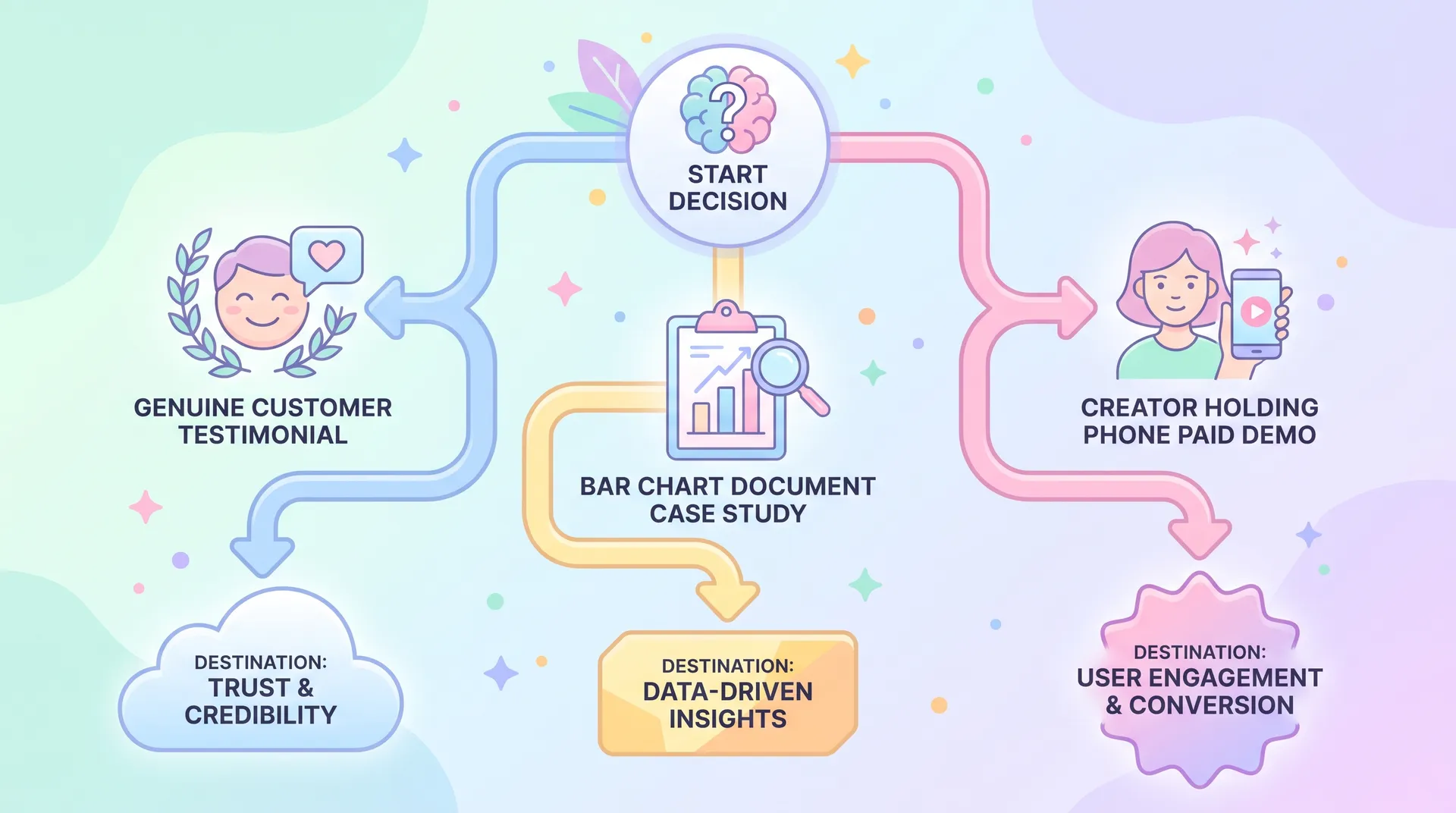
- Is the goal trust or discovery? Trust → testimonial or case study. Discovery → creator demo.
- Is the buyer early or late funnel? Early → creator demo or short testimonial clip. Late → case study or detailed testimonial.
- Does the claim need numbers a reader will scrutinize? If yes, write it as a case study — don't make someone pause a video to screenshot a stat.
- Do you even have a customer who'd make a good testimonial yet? If you're pre-PMF or launching something brand new, you might not. That's when a paid creator demo is honestly your best option, not a compromise.
Matching the asset to the actual objection matters more than most teams think. We go deeper on this in matching video testimonials to your buyers' objections — the short version is that a generic "great product!" testimonial does almost nothing against a specific pricing or integration objection. Specificity is the whole point.
If you're unsure which customers even make good testimonial subjects, start with our guide on choosing the right customers for video testimonials before you book a single shoot.
Don't mix the budgets
One more thing I've seen go wrong repeatedly: teams take their "social proof" budget and split it evenly across all three formats, regardless of funnel stage or need. That's backwards. Figure out where your biggest leak is — is it top-of-funnel attention, or bottom-of-funnel trust at the point of purchase? — and overweight the format that fixes that leak specifically.
A B2B SaaS company selling $500/month subscriptions to small teams probably needs more testimonials and fewer long case studies. An enterprise tool selling six-figure annual contracts needs the opposite. A consumer app trying to get installs needs creator demos way more than either.
FAQ
Frequently Asked Questions
What makes a good video testimonial example?
Can a paid creator demo double as a testimonial?
Do case studies still work without a video testimonial attached?
Where should I place video testimonials on my website?
How many video testimonial examples do I need before launching a program?
If you walk away with one thing: stop asking "should we do video testimonials or case studies or creator content" like it's a single budget line. Ask what specific doubt you're trying to kill at each stage of your funnel, then pick the format built to kill it.
Related reading
- How to Build a Customer Video Testimonial Program for SaaS
- Matching Video Testimonials to Your Buyers' Objections
- How to Choose the Right Customers for Video Testimonials
- How to Ask for Testimonials: Timing by Lifecycle Stage
- What is a UGC creator? (And what it means in 2025)
- How to hire UGC creators: a brand marketer's checklist