How to Write UGC Hooks for Different Products by Category
Learn how to write UGC hooks for different products with category-specific formulas for beauty, food, fitness, home, and tech that match buyer psychology.

I've watched a $40 UGC video get zero conversions and a $150 UGC video get pulled into a brand's paid ad account within 24 hours of delivery. The difference almost never came down to lighting or editing. It came down to the first line.
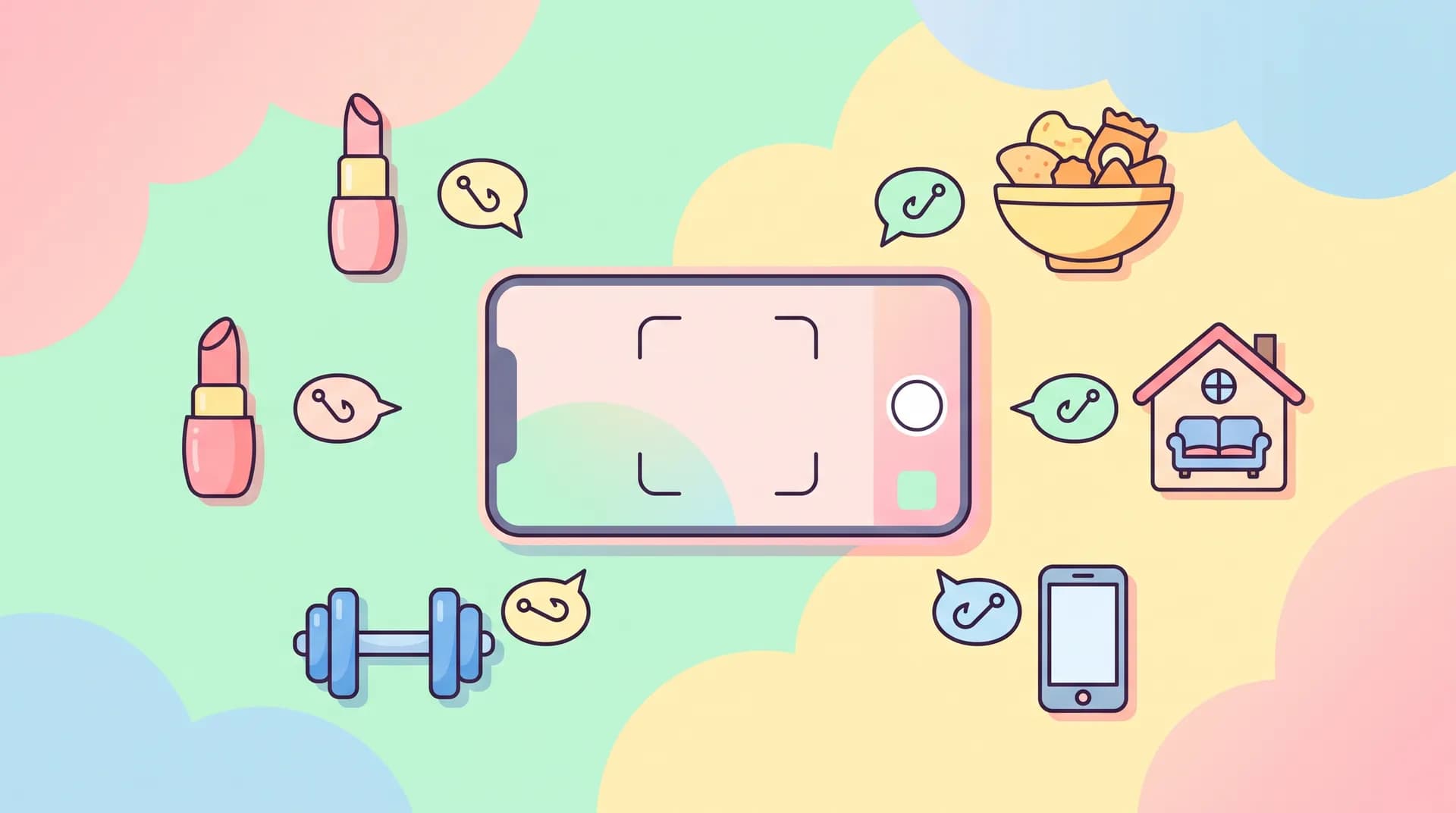
Creators love to treat hooks like they're one universal skill — learn "POV: you just found out..." and apply it everywhere. That's why so many videos flop. A hook that crushes for a $12 lip oil will fall flat for a $400 air purifier, because the person watching is in a completely different headspace. Beauty buyers want to feel something. Tech buyers want to be convinced. Food buyers want to salivate. Fitness buyers want proof. Home buyers want relief from annoyance.
If you're writing the same hook style for every brief you get, you're leaving money on the table. Let's break this down by category so you can match the opening line to what that specific buyer actually cares about.
Why hooks need to match buyer psychology, not just platform trends
Most hook advice out there is platform-agnostic — "use a pattern interrupt," "ask a question," "show the result first." All true, but incomplete. A hook works because it taps into the specific anxiety, desire, or curiosity of someone shopping in that category. Writing a UGC hook without thinking about the product category is like writing a cold email without knowing the recipient's job title.
I built Flare.app around this exact insight: creators who understand what a beauty buyer fears versus what a tech buyer questions consistently land more repeat bookings, because their content actually performs in the brand's ad account. Brands notice which creators generate hooks that convert, and they come back to those creators specifically.
If you haven't already, read our full guide on filming UGC content that converts — hooks are step one, but the shot composition and pacing that follow matter just as much. This post zooms in on that critical first line, category by category.
The core hook formula that still applies everywhere
Before category specifics, one rule holds across all of them: your hook needs to happen in the first 1-2 seconds, ideally before your face is even fully in frame. Whether it's a visual hook (holding up the product oddly) or verbal (a bold claim), the viewer needs a reason to not swipe within that window. For more on the mechanics of that opening window, check out UGC video hooks: stop the scroll in 3 seconds.
Now let's get specific.
Beauty hooks: sell the transformation and the feeling
Beauty buyers are shopping on insecurity and aspiration at the same time. They've tried things that didn't work. They're skeptical but hopeful. Your hook needs to acknowledge that skepticism before it sells anything.
Formulas that work:
- "I've tried every [product type] on TikTok and this is the first one that actually [specific result]"
- "Nobody talks about this but [common beauty problem] is actually caused by [surprising cause]"
- "POV: your dermatologist tells you to stop doing [common mistake]"
- "This $18 product replaced my $90 [luxury alternative]"
The mistake I see constantly: creators open beauty videos with "Hey guys, today I'm going to show you..." That's a scroll-past. Beauty audiences respond to specificity and a slight edge of controversy — "actually," "nobody talks about," "stop doing this" — because it signals insider knowledge they don't want to miss.
Pair your hook with a close-up shot of texture or application, since beauty content lives and dies on visual satisfaction. If you need help with that framing, our piece on rule of thirds and composition covers how to keep product texture the visual focus without cluttering the frame.
Food and beverage hooks: trigger a craving in the first frame
Food buyers make decisions with their eyes and stomach before their brain catches up. Your hook doesn't need to be clever — it needs to make someone hungry or curious about a flavor combo they haven't tried.
Formulas that work:
- "This is the [dish/snack] that broke the internet and I finally tried it"
- "I was today years old when I found out you can [surprising use of the product]"
- "Rating this [snack/drink] so you don't have to waste your money"
- Straight visual hook: the pour, the cheese pull, the crunch — no words needed for the first second
Food is one of the only categories where a wordless hook can outperform a verbal one. A satisfying ASMR-style pour or bite in the first half-second does more than any line of dialogue. If you're filming these, natural light matters enormously for making food look appetizing rather than gray and flat — our guide on filming with natural light at any time of day is worth a read before your next food shoot.
Where food hooks fail: over-explaining before showing the product. Nobody wants to hear about your day before they see the food. Cut straight to it.

Fitness hooks: lead with proof, not motivation
Fitness buyers are the most skeptical audience on this list. They've seen a thousand "this changed my body" claims that turned out to be lighting tricks and filters. Your hook needs to lean into proof, specificity, and time frames — vague motivation gets skipped instantly.
Formulas that work:
- "3 weeks using this every morning and here's what actually happened"
- "I stopped doing [common fitness advice] and started doing this instead"
- "This is the only [equipment/supplement] I've kept using past week 2"
- "POV: you finally found the [product] that doesn't feel like a gimmick"
Notice the pattern — real timeframes, real specificity, and an implicit admission that other things failed first. That admission builds trust fast. If your brief calls for a before-and-after format, the hook and the payoff need to be planned together from the start; our guide on filming a UGC before-and-after video walks through pacing that so the reveal actually lands.
Fitness audiences also respond well to hooks filmed mid-motion — starting the video already in a set or already out of breath signals authenticity that a static "hey guys" intro can't fake.
Home and lifestyle hooks: solve an annoyance they didn't know had a fix
Home product buyers are shopping to remove friction from daily life. The best hooks in this category name a tiny, universal annoyance the viewer has felt but never articulated.
Formulas that work:
- "If your [common household object] always [specific annoying behavior], you need this"
- "I didn't know I needed this until my [family member] used it and now I can't live without it"
- "This solved a problem I didn't even know I had"
- "The way I've been doing [household task] wrong my whole life"
Home category hooks work best paired with a quick before/messy shot cut to after/clean shot — visual proof of the annoyance being solved in real time. This is a category where good b-roll does half the hook's job for you. Our guide on shooting b-roll that sells has specific setups for capturing that "problem, then relief" sequence cleanly.
Tech hooks: answer the objection before they think it
Tech buyers are the most research-driven audience here. They're comparing specs, reading reviews, and assuming most claims are exaggerated. Your hook has to preempt an objection instead of just showing off a feature.
Formulas that work:
- "I was skeptical this [product] could actually [claim] — here's what happened"
- "You don't need to spend $[high price] to get [desired result], here's proof"
- "This is the one [tech product] that didn't end up in my drawer"
- "3 things nobody tells you before buying a [product category]"
Tech hooks age poorly if they're all hype and no substance, because this audience clicks away the second something sounds like a paid ad without evidence. A talking-head delivery with genuine, slightly skeptical energy tends to outperform overly polished delivery in this category — see our notes on on-camera delivery that builds trust for tone calibration.
Before you write a single hook, ask yourself one question: what has this specific buyer already been burned by? Beauty buyers were burned by hype. Fitness buyers were burned by fake transformations. Tech buyers were burned by inflated specs. Write your hook as the answer to that specific burn, not a generic scroll-stopper.
Testing hooks across categories without guessing
Here's the part most creators skip: you don't actually know which hook formula will win until you test it against real audience behavior. I've had creators swear a certain hook style would flop, then watch it become the top performer in a brand's ad account because it matched the audience better than expected.
If you're delivering multiple hook variations per brief (which you should be — most brands now expect 3-5 hook options minimum), keep a simple log of which formula you used for each variation and how it performed once the brand shared results. Over a few months, you'll build your own category-specific playbook that's more reliable than any formula list, including this one.
This is also where a lot of creators start treating hook-writing as a real line item in their business rather than a five-minute afterthought before filming. If you're investing time into testing and tracking hooks properly, it's worth thinking about what other tools are actually worth paying for — our breakdown of UGC creator business expenses worth the money covers where that spend makes sense.
For a deeper structural approach to the entire script — not just the opening line — the Problem-Agitate-Solve framework pairs well with everything above, since your hook is really just the "Problem" step compressed into one sentence.
FAQ
Frequently Asked Questions
How do I write a UGC hook for a product I've never used before?
Should hooks be different for TikTok vs. Instagram Reels?
How many hook variations should I write per brief?
What's the biggest hook mistake beginners make?
Do wordless hooks work as well as spoken ones?
How do I know if my hook is actually working?
Related reading
- How to film UGC content that converts (full guide)
- UGC video hooks: stop the scroll in 3 seconds
- TikTok UGC hook examples: nail the first 3 seconds
- UGC scripting: the Problem-Agitate-Solve framework
- UGC video ideas: 12 high-converting formats with examples
External resources worth reading: HubSpot's guide to UGC marketing, Meta's Creative Best Practices for ad hooks, and Nielsen's research on consumer trust in UGC.