W-8BEN for UGC creators: non-US tax forms explained
Non-US UGC creator working with American brands? Learn how to fill out the W-8BEN and W-8BEN-E to avoid wrongful 30% tax withholding on your payments.

A creator in Australia landed a $1,200 UGC deal with a US skincare brand. Everything went smoothly — concept approved, videos delivered, client happy. Then the payment arrived: $840. The brand's finance team had automatically withheld 30% because she hadn't submitted a W-8BEN form.
That $360 wasn't stolen. It was sitting with the IRS. And recovering it meant filing a US tax return as a non-resident alien — a process that took months and cost her more in accountant fees than the withholding itself.
This happens constantly to non-US UGC creators working with American brands. The fix takes about 10 minutes. The form is called the W-8BEN — and if you're outside the US and getting paid by US companies, you need to understand it before your next invoice lands.
What the W-8BEN actually is (and why it matters for non-US UGC creators)
The W-8BEN is an IRS form — "Certificate of Foreign Status of Beneficial Owner for United States Tax Withholding and Reporting." That mouthful basically means: a document that proves to a US-based payer that you're not a US person, so they know how to handle your payment correctly.
Here's the default situation without it. Under US tax law, any US company paying a foreign individual for services is required to withhold 30% of the payment and send it to the IRS. They're not doing it to be difficult. They're legally required to, and if they don't, they become liable.
Submit a valid W-8BEN, and two things happen:
- You certify your foreign status, which removes the withholding obligation in many cases
- If your country has a tax treaty with the US, you may be entitled to a reduced withholding rate — sometimes 0%
Countries like the UK, Canada, Australia, Germany, and most of the EU have tax treaties with the US that reduce or eliminate withholding on freelance service income. If you're in one of those countries and you're not submitting a W-8BEN, you're giving away money.
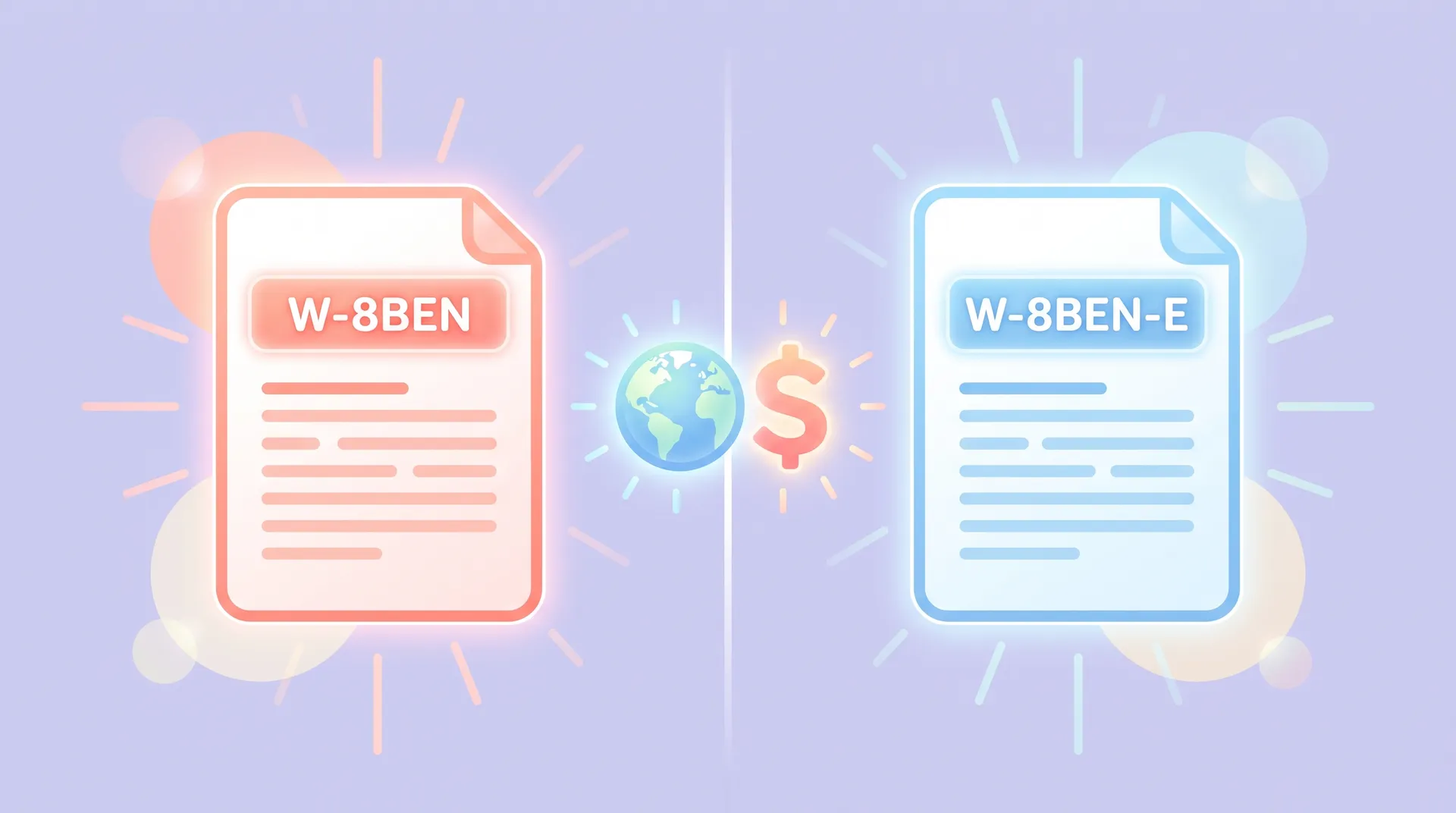
The W-8BEN is for individuals. If you operate through a registered business entity — an LLC, Ltd, PTY, or similar — you need the W-8BEN-E instead. More on that below.
W-8BEN vs. W-8BEN-E: which form do you need?
Simple rule:
W-8BEN → you're a foreign individual getting paid personally
W-8BEN-E → you're a foreign entity (a company, LLC, or other business structure) getting paid
Most UGC creators just starting out are paid as individuals, so W-8BEN is your form. But if you've set up a business entity to invoice through — even a simple sole trader structure in some countries — check with your local accountant about whether you need the -E version.
The W-8BEN-E is significantly more complex. It has 30 sections and requires you to classify your entity type under US tax rules, which isn't always intuitive depending on your country. If you need the -E, I'd strongly recommend getting professional help for the first filing.
For the rest of this post, I'll focus on the individual W-8BEN since that's what most non-US UGC creators need.
How to fill out the W-8BEN: field by field
You can download the current version directly from the IRS website. Always use the IRS version — don't use a brand's pre-filled PDF unless you've confirmed it's current.
Part I — Identification of Beneficial Owner
- Line 1: Your full legal name as it appears on your passport or government ID
- Line 2: Your country of citizenship (not residency — citizenship)
- Line 3: Permanent residence address — your actual address, not a PO box. This must match the country you're claiming treaty benefits for
- Line 4: Mailing address, if different
- Line 5: US Taxpayer Identification Number — most foreign creators don't have one, and that's fine. Leave it blank unless you have an ITIN or SSN
- Line 6: Foreign tax identifying number — this is your tax ID number from your home country. In the UK it's your UTR or NI number. In Australia, your ABN or TFN. In Canada, your SIN. Fill this in
- Line 8: Date of birth — in MM-DD-YYYY format (US style)
Part II — Claim of Tax Treaty Benefits
This is the section most people skip, and it's often the most valuable.
If your country has a tax treaty with the US, you can claim a reduced withholding rate here. Enter your country of residence for treaty purposes, then cite the specific article that applies to your income type.
For independent services income (which is what UGC work is), the treaty article is typically Article 7 (Business Profits) or Article 14 (Independent Personal Services), depending on the treaty. The IRS treaty tables list every active treaty — find your country, click through to the treaty text, and look for the relevant article.
For most UK, Canadian, Australian, and EU creators, this reduces withholding to 0% on service income. That's the whole game right there.
Part III — Certification
Sign, date, and confirm you're authorized to sign. Don't backdate it.
The W-8BEN is valid for 3 years from the date of signature (or until your circumstances change). Set a calendar reminder to renew it. If it expires and a brand doesn't have a valid form on file, they'll revert to withholding 30%.
When brands ask for this — and how to send it
Most established US brands and agencies that regularly work with international creators will ask for the W-8BEN upfront as part of their onboarding paperwork, alongside the contract. If they don't ask, send it anyway when you send your first invoice.
Don't wait to be asked. Proactively including it signals that you're professional and have done this before.
A few practical points:
- Send it as a PDF, not a scanned paper form
- Keep a copy for yourself — you'll need it when you refresh in 3 years
- If a brand's platform uses a vendor portal (Tipalti, Bill.com, and similar tools are common), you'll usually complete this digitally as part of the payment setup flow
- Never send it over an unencrypted email with your foreign tax ID visible. Use a password-protected PDF or a secure file-sharing link
If a brand withholds despite you having submitted a valid form, that's an error on their end — escalate to their finance team immediately. Check your contract too; the invoicing and payment terms you agreed to should specify net payment amounts.
The bigger picture: your rights around payment and contracts
The W-8BEN sits inside a wider web of financial protection you need as a non-US creator doing business with US brands.
Understanding how your payment rights connect to your contract is non-negotiable. If a US brand owes you $2,000 for three videos, you want that full $2,000 — not $1,400 after an erroneous withholding that takes 18 months to recover. The W-8BEN is one layer of protection.
The other layers live in your contract itself. I'd strongly recommend reading our UGC usage rights: the complete creator guide to understand how payment structures connect to the rights you're granting — especially around usage periods and platforms. The rights you grant directly affect the value of what you're charging, and that affects the payment amounts we're talking about protecting here.
For non-US creators specifically, watch for contract clauses that try to classify you differently than you are. Some US brands will issue 1099-NEC forms to foreign creators out of habit — that's incorrect (1099s are for US persons). If you receive one, it doesn't change your tax obligation in the US if you've properly submitted a W-8BEN, but you should flag it to the brand. Our UGC creator taxes post covers the US tax form landscape in more detail for context.
Also worth having locked down: your kill fee clauses and revision limits. Cross-border deals that go sideways are significantly harder to resolve than domestic ones, so your contract needs to be airtight before you start filming.
And if payment goes late or stops entirely, chasing late payments from brands covers exactly how to escalate — including what leverage you actually have across borders.
What happens if you don't submit the form and get hit with withholding
You have two options.
Option 1: Ask the brand to adjust the next payment. If you have an ongoing relationship, the simplest fix is to submit the W-8BEN now, and ask the brand to add the wrongfully withheld amount to your next payment. Many will do this without issue once they understand what happened.
Option 2: File for a refund from the IRS. You'd file Form 1040-NR (Non-Resident Alien Income Tax Return) to claim back amounts withheld that you weren't liable for under a treaty. This is slow (6–12 months), and you'll likely need an ITIN (Individual Taxpayer Identification Number) to file, which requires its own application process. Not fun.
Option 1 is clearly better. Which means the real answer is: submit the W-8BEN before the first payment, every single time.
Frequently Asked Questions
Do I need a W-8BEN as a non-US UGC creator working with US brands?
What's the difference between W-8BEN and W-8BEN-E for UGC creators?
How long is a W-8BEN valid?
What if a brand already withheld 30% from my UGC payment?
Do I put my foreign tax ID on the W-8BEN?
Which tax treaty article covers UGC creator income?
Related reading
- UGC usage rights: the complete creator guide
- How to invoice a brand as a UGC creator (step-by-step)
- UGC creator taxes: 1099s, quarterly payments & write-offs
- Kill fee for UGC creators: how to use them
- UGC revision limits: why your contract needs a cap
- Chasing late payments from brands: scripts & options
- How to read a UGC contract before you sign
- UGC contract red flags: 9 clauses to reject or edit