
Should UGC Creators Form an LLC? Pros, Cons & Timing
Wondering if an LLC for a UGC creator is worth it? Here's the honest breakdown of liability, taxes, costs, and the income level where it starts to make sense.

Last year, a creator I know got a letter from a brand's legal team. Not a friendly one. The brand claimed her unboxing video contained an "unsubstantiated product claim" and they wanted her to cover part of the settlement with the FTC-adjined advertiser. She'd made $400 on that deal. The letter threatened five figures.
She was a sole proprietor. Which meant there was no line between her business and her bank account. Her personal savings, her car, everything she owned — legally, it was all on the hook.
That's the day I stopped telling creators "an LLC can wait."
Here's my honest take after years in this space: forming an LLC for a UGC creator isn't sexy, it's not the first thing you should do, and most advice about it is either "do it day one!" or "you don't need it until $100K" — both wrong. Let me give you the actual framework I'd use.
What an LLC for a UGC creator actually protects you from
An LLC — limited liability company — does one core job: it separates your business liabilities from your personal assets. If a brand sues your LLC, they can generally only reach the LLC's assets. Your personal savings, your 401(k), your car? Off the table.
Now, let me be honest about how likely a lawsuit actually is for a typical UGC creator. You're not performing surgery. Most deals are a few hundred to a few thousand dollars. Nobody's suing over a $600 skincare video.
But there are real scenarios where liability shows up:
FTC and advertising claims. You said "this cleared my acne in a week" in a script the brand gave you. If that claim turns out to be problematic, you're the face on camera. As a sole proprietor, you're personally exposed. This is exactly why you need to read every contract before you sign it — including the indemnification clauses most creators skip.
IP disputes. You used a trending sound, a clip of a movie, or filmed something in a location you didn't have rights to. Brands pay for the content — and some contracts push IP liability onto the creator.
The thing nobody talks about: contract liability. You agreed to unlimited revisions without a cap, missed a deadline because a brand ghosted on approvals, and now they want their deposit back plus damages. A revision limit clause protects you in the contract. The LLC protects you if the contract fails.
One critical caveat: an LLC doesn't protect you from everything. It won't shield you from your own negligence or fraud, and if you commingle funds (paying your grocery bill from the business account), a court can "pierce the veil" and treat the LLC as fiction. You have to actually run it like a business.
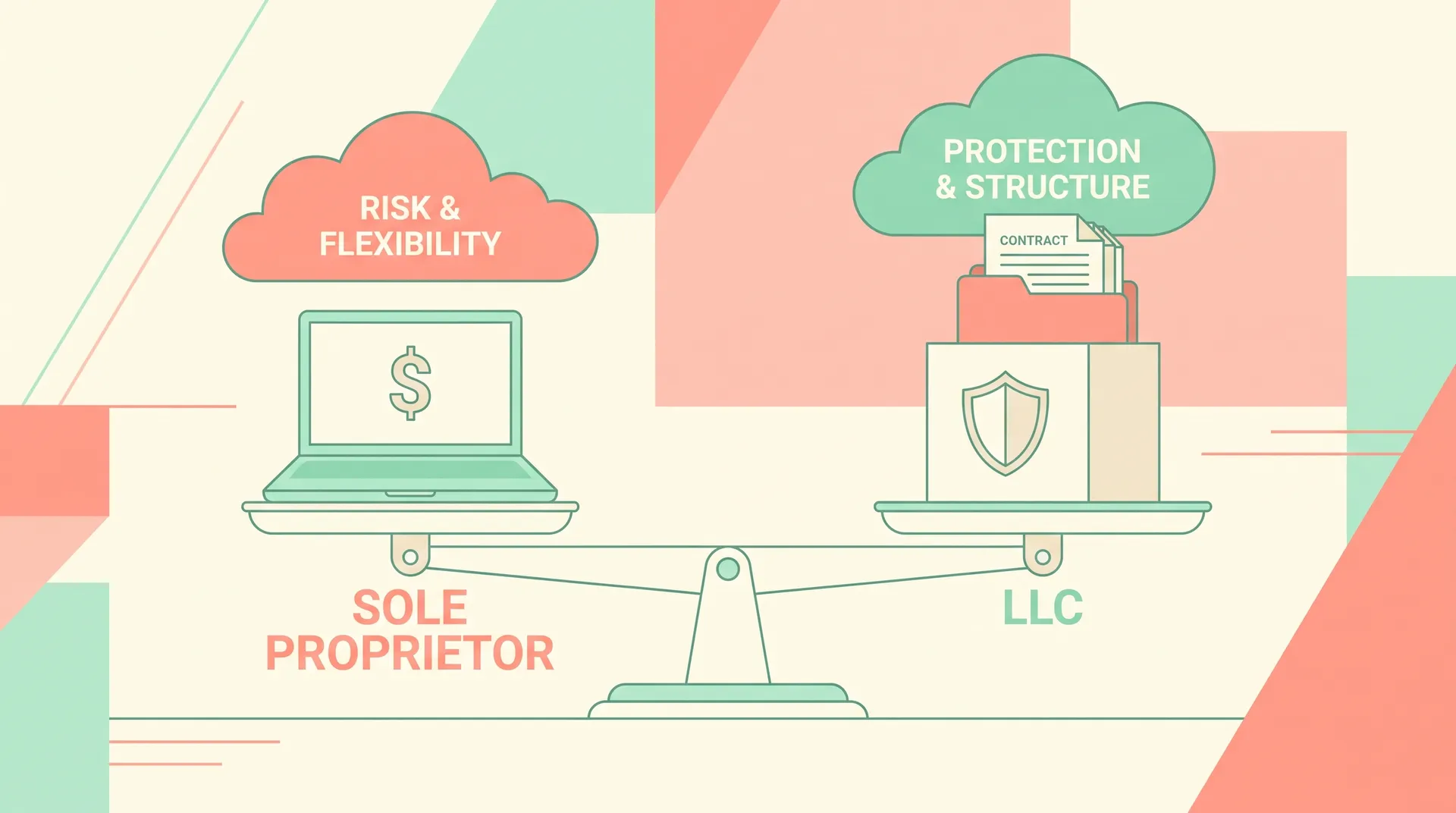
Sole proprietorship vs LLC: the real math for creators
When you start doing UGC, you're a sole proprietor by default. No filing, no paperwork. You just owe taxes on the income — which is exactly what our UGC creator taxes guide covers.
So what does an LLC change?
Taxes: almost nothing. A single-member LLC is a "disregarded entity" by default. The IRS taxes it exactly like a sole proprietorship. Same self-employment tax (15.3%), same Schedule C, same quarterly estimated payments. Anyone telling you an LLC "saves you on taxes" is conflating it with an S-corp election — more on that below.
Liability: everything. This is the only reason to form one, and it's a legitimate reason.
Credibility: a small real bump. Some bigger brands and agencies genuinely prefer invoicing "Creator Name LLC" over a personal name. It signals you're a business. I've seen it matter more for landing retainers and long-term ambassador deals than one-off gigs.
Cost: $50–$500 to form, plus $0–$800/year. Filing fees vary wildly by state — around $50 in Arizona, $500 in Massachusetts, and California hits you with an $800 annual franchise tax on top of the filing fee. That California fee alone is why I'd tell a brand-new California creator making $1,000/month to wait.
The comparison people actually search for is S corp vs LLC — but most creators ask the wrong version of that question. Let me fix that.
When to form an LLC: my honest thresholds
I've watched hundreds of creators go through this. Here's the pattern I'd use as a rule of thumb:
Under $10K/year: don't bother. You're testing whether this is even a business. Spend your energy on your portfolio and outreach, not filing fees. A sole proprietorship is fine. Track expenses carefully — that's the real win at this stage.
$10K–$30K/year: form one if any of these apply. You're doing paid ads content (whitelisted and dark-post material carries more exposure — our UGC whitelisting guide explains why brands push for those rights). You're in a claims-sensitive niche (supplements, finance, health, anything ingestible). Or a brand has ever asked you to indemnify them. If none apply, you can still wait.
$30K+/year: just do it. At this point you're a real business with real contracts. The $100–$500 filing fee is trivial against the exposure. And once you're here, you should also be thinking about the S-corp question, because the math changes.
The niche matters more than people realize. If you film mostly beauty and lifestyle products from established brands with their own legal review, your risk is lower. If you're scripting your own claims for a supplement startup with no compliance team? Form the LLC before your next shoot. Not after.
Before deciding, ask yourself three questions: (1) Have I ever signed a contract with an indemnification clause? (2) Do any of my videos make product claims I didn't verify? (3) Is my personal savings account bigger than one year of UGC income? Two or more "yes" answers — form the LLC.
The S-corp question: where creators actually save money
Here's where the real tax money is, and it's not the LLC itself.
Self-employment tax is 15.3% on all your net business income. With an S-corp election, you pay yourself a "reasonable salary" — subject to payroll tax — and the remaining profit passes through as distributions, which skip self-employment tax entirely.
Quick math on a creator netting $80K:
- As a sole proprietor or plain LLC: ~15.3% self-employment tax on the full $80K
- As an LLC with an S-corp election: pay yourself, say, $45K salary (payroll tax on that), and take $35K as distributions
That saves roughly $5,300 in self-employment tax. But payroll comes with costs — you need to run actual payroll (services like Gusto run ~$40–$60/month), file payroll tax returns, and do more bookkeeping. Realistically that eats $1,500–$2,500 of the savings.
The breakeven is somewhere around $50K–$60K in net profit. Below that, an S-corp costs more than it saves. Above $70K, it's almost always worth a conversation with a CPA.
The SBA has a solid overview of business structures if you want to compare all the options side by side.
The cons nobody mentions
I'd be a hypocrite if I only sold you the upside. Here's what an LLC costs you beyond the filing fee:
Paperwork forever. Annual reports, registered agent maintenance, separate bank account, separate bookkeeping. It's not hard, but it's another thing to forget — and forgetting can mean your state dissolves your LLC administratively. Yes, that happens.
Commingling risk. One messy month of using the business account for personal stuff undermines the entire liability shield. If you're not disciplined enough to keep two accounts clean, the LLC is a false sense of security.
Perpetuity clauses don't care. I'll say this plainly: an LLC doesn't protect you from signing bad contracts. A perpetuity usage clause or a vague license grant will cost you money no matter what business entity you use. Entity structure and contract hygiene are two separate defenses. You need both.
It can slow you down psychologically. I've watched creators spend two weeks researching LLC formation and zero weeks pitching brands. The entity is insurance, not a business. Revenue first, structure second.
How to form one without overpaying
If you've hit the thresholds, here's the cheap path:
- File in your own state. Not Wyoming, not Delaware — whatever YouTube gurus say. You live and work in your state; a foreign state LLC just means registering twice. File directly with your Secretary of State's website.
- Skip the $300+ formation services. They upsell you on things you can do yourself in 20 minutes: getting an EIN from the IRS is free and takes about five minutes online.
- Be your own registered agent if you have a stable address (or pay ~$100/year for a service if you move a lot or don't want your home address on public record).
- Open a business bank account immediately. This is the step that actually makes the liability shield enforceable. Don't skip it.
- Write a one-page operating agreement, even as a single member. Some states require it; courts care about it.
Total cost in most states: under $200. Total time: an afternoon.
One more thing — getting the LLC changes nothing about how you invoice or get paid, except the name on the invoice. If you're still struggling with the payment side, our guides on invoicing brands correctly and chasing late payments apply to you either way.
The creators who get burned aren't the ones who skipped the LLC. They're the ones who never read their contracts, never capped their revisions, and never separated their money. Do those three things first. Then, when the income and the claims-heavy deals stack up, the LLC is a two-hour errand — not a panic move after a legal letter shows up.